Tag Archives: Worship

THE THREE GREAT DISPENSATIONS — BOB PRICHARD

Our God is an unchanging God, but when we survey Bible history we find that in different times, God had different requirements for mankind. The Bible reveals three great dispensations, or general statements of the order of things. Each dispensation had specific requirements for what God desired of man, including three different systems of worship. Paul told Timothy, “Study [give diligence] to show thyself approved unto God, a workman that needeth not to be ashamed, rightly dividing the word of truth” (2 Timothy 2:15). By “rightly dividing” the scriptures, we may see what applies to man in each age, and most importantly, what applies to us in the present age. The three great dispensations or systems are classified as the Patriarchal Age, The Mosaic Age, and the Christian Age.

I. THE PATRIARCHAL AGE.

During the Patriarchal age, which began with Adam and continued down to the time of Moses, God spoke directly to the fathers, or heads of households.

An example of this age is God’s call to Abram, later to become Abraham. “Now the LORD had said unto Abram, Get thee out of thy country, and from thy kindred, and from thy father’s house, unto a land that I will show thee: And I will make of thee a great nation, and I will bless thee, and make thy name great; and thou shalt be a blessing: And I will bless them that bless thee, and curse him that curseth thee: and in thee shall all families of the earth be blessed” (Genesis 12:1-3). There was no intermediary between God and Abram. God spoke directly to him.

God promised father Abraham: “And the LORD appeared unto Abram, and said, Unto thy seed will I give this land: and there builded he an altar unto the LORD, who appeared unto him. And he removed from thence unto a mountain on the east of Beth-el, and pitched his tent, having Beth-el on the west, and Hai on the east: and there he builded an altar unto the LORD, and called upon the name of the LORD” (Genesis 12:7-8).

Job also lived in the Patriarchal Age. “And it was so, when the days of their feasting were gone about, that Job sent and sanctified them, and rose up early in the morning, and offered burnt offerings according to the number of them all: for Job said, It may be that my sons have sinned, and cursed God in their hearts. Thus did Job continually” (Job 1:5).

Neither Job nor Abraham needed a priest to intervene for him. He dealt directly with God.

II. THE MOSAIC AGE.

The second great dispensation is called the Mosaic Age, because it began with the giving of the Law of Moses to the Jews by Moses. This age lasted from the time of Moses until the cross of Christ. The people were guided by the Ten Commandments as well as the other laws of Moses. The religious system was based on animal sacrifices, and was guided by Aaron, the first high priest, and then by his descendants, all from the tribe of Levi.

This worship system was adequate for a time for the Jews, but a newer, better system was planned by God, which was implemented by Christ in the next age, just as the prophets said that it would be. The book of Hebrews deals with this issue of the new Christian Age, and its superiority to the Mosaic Age.

 “But now hath he obtained a more excellent ministry, by how much also he is the mediator of a better covenant, which was established upon better promises. For if that first covenant had been faultless, then should no place have been sought for the second. For finding fault with them, he saith, Behold, the days come, saith the Lord, when I will make a new covenant with the house of Israel and with the house of Judah: Not according to the covenant that I made with their fathers in the day when I took them by the hand to lead them out of the land of Egypt; because they continued not in my covenant, and I regarded them not, saith the Lord. For this is the covenant that I will make with the house of Israel after those days, saith the Lord; I will put my laws into their mind, and write them in their hearts: and I will be to them a God, and they shall be to me a people: And they shall not teach every man his neighbour, and every man his brother, saying, Know the Lord: for all shall know me, from the least to the greatest” (Hebrews 8:6-11).

Notice that the new covenant is a better covenant, because it is based on better promises. The emphasis of the Christian Age is not on externals, but on a heart devoted to obeying God.

III. THE CHRISTIAN AGE.

Jesus said, “Think not that I am come to destroy the law, or the prophets: I am not come to destroy, but to fulfil” (Matthew 5:17). No man was able to keep the Law of Moses perfectly, but Jesus Christ did. And in so doing He fulfilled the Law. And with His death, He implemented the new Christian Age.

On the day of Pentecost, an important Jewish feast day, the Holy Spirit gave the apostles the power to speak in other languages, causing confusion for the people, making some think that they were drunk. But Peter said, “These are not drunken, as ye suppose, seeing it is but the third hour of the day. But this is that which was spoken by the prophet Joel; And it shall come to pass in the last days, saith God, I will pour out of my Spirit upon all flesh” (Acts 2:15-17a). The events of the day fulfilled the prophecy of Joel of what would happen in the last days, that is, the beginning of the final age, the Christian Age.

Peter’s sermon moved the people to ask “What shall we do? Then Peter said unto them, Repent, and be baptized every one of you in the name of Jesus Christ for the remission of sins, and ye shall receive the gift of the Holy Ghost. For the promise is unto you, and to your children, and to all that are afar off, even as many as the Lord our God shall call” (Acts 2:38-39). Thus was the beginning of the church, and the new Christian Age. Those who believed the message that Jesus is the Christ and were willing to obey God by repenting of their sins and confessing their faith in Christ and being baptized were added by Christ to His church (Acts 2:47).

With the new Christian Age, the New Testament system of worship was implemented, retaining some aspects of Mosaic worship, but changing others. God was animal sacrifice and the temple worship with instrumental worship by the Levites, and added to the worship was the Lord’s Supper, a memorial feast to the sacrifice of Christ.

In the Christian Age, rather than having a formal priesthood drawn from the tribe of Levi, as existed under the Mosaic, all Christians are priests (1 Peter 2:9). If we can help you understand this better covenant we have in Jesus Christ, please let us know.
MUST I BE A MEMBER TO PARTAKE OF COMMUNION IN THE CHURCH OF CHRIST? — BOB PRICHARD

The question of who may partake of communion has long been controversial. Some religious groups practice “closed communion.” In “closed communion,” a person who is not a member of the particular church may not partake of communion. Some even go so far as to forbid other members of the religious group to participate if they are not members of that particular congregation. The alternative to “closed communion” is “open communion,” in which the individual decides whether he will partake of communion.

The idea of “closed communion” comes from the belief that church officials not only have the right, but the duty to see that they bar the unworthy from participating in the Lord’s Supper. The Lord’s Supper, however, is only one of the five acts of worship authorized in the New Testament. (The other acts of worship specified in the New Testament are singing, praying, giving, and teaching the Bible.) Since the Lord’s Supper is only one of these specified acts of worship commanded in the Bible, consistency would demand that the person barred from partaking of the Lord’s Supper should be barred from the other acts of worship.

Paul records Christ’s command to observe the Lord’s Supper: “For I have received of the Lord that which also I delivered unto you, That the Lord Jesus the same night in which he was betrayed took bread, And when he had given thanks, he brake it, and said, Take, eat: this is my body, which is broken for you: this do in remembrance of me. After the same manner also he took the cup, when he had supped, saying, This cup is the new testament in my blood: this do ye, as oft as ye drink it, in remembrance of me.” Paul then warns, “Wherefore whosoever shall eat this bread, and drink this cup of the Lord, unworthily, shall be guilty of the body and blood of the Lord. But let a man examine himself, and so let him eat of that bread, and drink of that cup. For he that eateth and drinketh unworthily, eateth and drinketh damnation to himself, not discerning the Lord’s body” (1 Corinthians 11:23-25, 27-29). The warning about partaking “unworthily” has confused many. “Unworthily” is an adverb, describing the manner of worship, not the worthiness of the worshiper.

Paul also states that each person is to “examine himself,” not to “examine his brother.” “Closed communion” makes a church, or its representatives the judge of a worshiper’s worthiness. But each must examine himself, and each who comes to worship must be “discerning the Lord’s body.” Paul said that Christ is the “head of the body, the church” (Colossians 1:18). Proper examination, and discerning of the Lord’s body would include asking oneself, “Have I done everything the Lord requires to add me to his body, the church?” and, “Am I sincere, with the right attitude of heart?”

No one has the right to “examine” another concerning the Lord’s Supper, forbidding him to participate. The Lord’s supper is for Christians. The one who partakes of the Lord’s Supper without properly examining himself, discerning the Lord’s body, and being willing to make the necessary changes, disobeys God. What we do in worship, and how we do it really matters! God has not left us to our own devices to decide how to worship Him!

“HOLY GROUND” — BOB PRICHARD

Harry Truman personally persuaded Adlai Stevenson to run for the Democratic Party nomination in 1952. He invited Stevenson to spend the night in the Lincoln Room at the White House. Stevenson walked around the room that night, gazing at the things in it. In awe of his surroundings, Stevenson couldn’t bring himself to sleep on the bed, and chose to sleep on the sofa instead. It wasn’t until later that he learned that the bed was not in the room in Lincoln’s time, but the sofa was.

If Adlai Stevenson could be in awe in the Lincoln Room, think how Moses must have felt when he turned aside to look at the burning bush. “And when the Lord saw that he turned aside to see, God called unto him out of the midst of the bush, and said, Moses, Moses. And he said, Here am I. And he said, Draw not nigh hither: put off thy shoes from off thy feet, for the place whereon thou standest is holy ground. Moreover he said, I am the God of thy father, the God of Abraham, the God of Isaac, and the God of Jacob. And Moses hid his face; for he was afraid to look upon God” (Exodus 3:4–6).

All of this makes me wonder why so many take opportunities for worship so lightly. When Christians gather for worship, they are in the very presence of God, The Lord said, “Again I say unto you, That if two of you shall agree on earth as touching any thing that they shall ask, it shall be done for them of my Father which is in heaven. For where two or three are gathered together in my name, there am I in the midst of them” (Matthew 18:19–20). Do you realize that when we gather together, the Lord is there with us?

You have an appointment with the Lord this Sunday. What is more important than that? See you on the Lord’s Day.

WHAT DID JESUS MEAN WHEN HE SAID “SALVATION IS OF THE JEWS”? — BOB PRICHARD

John chapter 4 describes the scene at the well outside the little Samaritan village of Sychar. Jesus had offered the Samaritan woman living water, and demonstrated He could truly give her that living water by telling her about her life, and her many husbands. Her wondering response was, “Sir, I perceive that thou art a prophet” (John 4:19). When she spoke of the conflict between the Jews and the Samaritans over whether men should worship in Jerusalem or Mount Gerizim, Jesus spoke of the proper worship then and in the days to come. He said, “Ye worship ye know not what: we know what we worship: for salvation is of the Jews” (John 4:22).

Jesus wanted her to understand that Samaritan worship, based on only the five books of Moses, while rejecting the other inspired books of the Old Testament, was an ignorant worship. “Ye worship ye know not what,” He said. Then He spoke of the Jewish worship, saying, “we know what we worship.” The Samaritan worship was not acceptable to God, because it was a perversion of His plan. The worship of the Jews, centered in the temple at Jerusalem, was still acceptable to God at this time, even though the scribes and Pharisees had made their own worship vain. “But in vain they do worship me, teaching for doctrines the commandments of men” (Matthew 15:9).

When Jesus added to His statement, “for salvation is of the Jews,” He was referring to the fact that Messiah, the Savior of promise, was to come from the Jews. God promised Abraham, the father of the Jewish nation, “I will bless them that bless thee, and curse him that curseth thee: and in thee shall all families of the earth be blessed” (Genesis 12:3). When the woman at the well spoke of the coming Messiah, Jesus plainly told her,  “I that speak unto thee am he” (John 4:25-26). Thus through the Messiah, Jesus Christ, the seed, or descendant of Abraham, God blessed all families of the earth.

The Jews today, like any other family or nation, must turn to Christ for salvation. Jesus told the woman at the well, “the hour cometh, and now is, when the true worshippers shall worship the Father in spirit and in truth: for the Father seeketh such to worship him. God is a Spirit: and they that worship him must worship him in spirit and in truth” (John 4:23-24). Jesus contrasted the Jewish age in which he lived and died with the coming Christian age. Jerusalem was the center of Jewish worship, but worship in the Christian age is acceptable whenever and wherever Christians worship “in spirit and in truth.” Jesus said, “I am the way, the truth, and the life: no man cometh unto the Father, but by me” (John 14:6). He is still the only way to the Father, for the Jew, the Gentile, the Samaritan, or anyone else. Paul asserted that the true heirs of Abraham are not heirs by birth but by faith. “For the promise, that he should be the heir of the world, was not to Abraham, or to his seed, through the law, but through the righteousness of faith. For if they which are of the law be heirs, faith is made void, and the promise made of none effect” (Romans 4:13-14).

SHOULD WE KNEEL IN PRAYER? — BOB PRICHARD

Worship that is acceptable to God has always involved the inner and the outer man. Jesus told the Samaritan woman at the well, “the hour cometh, and now is, when the true worshipers shall worship the Father in spirit and in truth: for the Father seeketh such to worship him. God is a Spirit: and they that worship him must worship him in spirit and in truth” (John 4:23-24). The word translated worship means “to bow down to the earth, to do obeisance before another.” The idea is to show reverence and humility before another. It can refer to bowing before men, such as when Abraham “bowed himself to the people of the land” (Genesis 23:7), but it usually refers to bowing before deity. Mordecai refused to bow before Haman (Esther 3:2). God warned Israel, “Thou shalt have no other gods before me. Thou shalt not make unto thee any graven image, or any likeness of any thing that is in heaven above, or that is in the earth beneath, or that is in the water under the earth: Thou shalt not bow down thyself to them, nor serve them” (Exodus 20:3-5 a). God alone deserves worship today.

The Psalmist says in Psalm 95:6, “O come, let us worship and bow down: let us kneel before the LORD our maker.” This is only direct mention of kneeling for worship in the King James Version, here used synonymously with “bow down” in the parallelism that marked Hebrew poetry. Ephesians 3:14 is a similar passage, where Paul says, “For this cause I bow my knees unto the Father of our Lord Jesus Christ,” asking God’s blessings on the Ephesian Christians. Certainly it would be right and proper to kneel for prayer, but it is not the only acceptable posture for prayer.

The usual posture for the Jews to offer prayers to God was to be standing, with uplifted hands. Paul told Timothy, “I will therefore that men pray every where, lifting up holy hands, without wrath and doubting” (1 Timothy 2:8). Jesus told a parable about a Pharisee and a publican (tax collector), who both went to the temple to pray. “The Pharisee stood and prayed thus with himself, God, I thank thee, that I am not as other men are, extortioners, unjust, adulterers, or even as this publican. I fast twice in the week, I give tithes of all that I possess.  And the publican, standing afar off, would not lift up so much as his eyes unto heaven, but smote upon his breast, saying, God be merciful to me a sinner. I tell you, this man went down to his house justified rather than the other: for every one that exalteth himself shall be abased; and he that humbleth himself shall be exalted”  (Luke 18:9-14). Both men stood, but the posture of their hearts was different. Only the publican, who prayed in humility, pleased God.

The outward posture of prayer may reflect something of the inward devotion of the worshiper. Kneeling may help the worshiper feel his need to humbly approach God. Whether a prayer is offered kneeling, standing, or lying down, however, the important issue is the attitude of the heart. “Pray without ceasing. In every thing give thanks: for this is the will of God in Christ Jesus concerning you” (1 Thessalonians 5:17-18).

“THE WHEELBARROW IN THE GARAGE” — BOB PRICHARD

Traveling evangelist Billy Sunday (1862-1935) once said, “Going to church don’t make anybody a Christian, any more than taking a wheelbarrow into a garage makes it an automobile.” There is plenty of truth here. The land is filled with church-going people who are less than they should be. They claim to be Christians, but their lives don’t show it. In The Scarlet Letter, Nathaniel Hawthorne said that “No man, for any considerable period, can wear one face to himself, and another to the multitude, without finally getting bewildered as to which may be the true.” The hypocritical life eventually catches up with even the most skillful of hypocrites.

Just “going to church” will not make anyone a Christian, but neither does staying away from church make anyone any better. There are hypocrites at church each Sunday morning, but there are even bigger hypocrites staying home, pretending that what they are doing is more important than meeting with the saints for worship. Even if some of the saints seem more like “ain’ts,” why would anyone who claims to have any interest in the things of God not be in worship?

Hebrews 10:23-25 reminds us of our responsibilities in worship. “Let us hold fast the profession of our faith without wavering; (for he is faithful that promised;) And let us consider one another to provoke unto love and to good works: Not forsaking the assembling of ourselves together, as the manner of some is; but exhorting one another: and so much the more, as ye see the day approaching.” When we assemble together, we must consider one another by provoking to love and good works, as well as exhorting one another. Power words like “provoking” and “exhorting” indicates that this is serious business.

There’s more to the story, though. The verses immediately following in Hebrews 10 warn, “For if we sin wilfully after that we have received the knowledge of the truth, there remaineth no more sacrifice for sins, But a certain fearful looking for of judgment and fiery indignation, which shall devour the adversaries. He that despised Moses’ law died without mercy under two or three witnesses: Of how much sorer punishment, suppose ye, shall he be thought worthy, who hath trodden under foot the Son of God, and hath counted the blood of the covenant, wherewith he was sanctified, an unholy thing, and hath done despite unto the Spirit of grace?” (10:26-29). It is a serious thing to forsake the assembly of the saints!

AMUSING OURSELVES TO DEATH — BOB PRICHARD

Neil Postman described serious problems in modern culture in his insightful 1985 book Amusing Ourselves to Death. His thesis was that public discourse has been reshaped to such an extent by television and entertainment that thoughtful discourse has been replace by “show business: hype, affecting advertising, politics and religion. Postman’s conclusion was that none of these changes have made for improvement. And he wrote, of course, before the internet social media revolution.

The problem with the modern entertainment orientation in religion is that the very object of worship is forgotten. God, who created and commanded worship is the “audience” for worship. “God is a Spirit: and they that worship him must worship him in spirit and in truth” (John 4:24). To worship God in spirit and in truth means that worship is from the heart, not just outward acts, and that it is done in exact obedience to God’s commands. Worship must be directed to Him, not to whims and desires of the worshipers.

God’s regulations for worship as set out in the New Testament are neither boring nor out of date. They are God-centered, while modern entertainment innovations in worship are men-centered. The most often used words related to worship in the New Testament denote the concepts of bowing down or kissing toward deity, offering devotion and love. This is what our worship must include.

There is nothing wrong with the worshiper enjoying worship. God intended the blessings of worship for all His children. But when worship is merely the window dressing for an entertainment performance, it cannot be pleasing to God. The apostle warned, “Whosoever transgresseth, and abideth not in the doctrine of Christ, hath not God” (2 John 9). Paul condemned things that “have indeed a show of wisdom in will-worship” (Colossians 2:23). “Will-worship” is worship fashioned after man’s desires, which God must reject. Worshiping God in spirit and in truth is more important than catering to man’s desire for entertainment.

TAKING HOLY THINGS FOR GRANTED — BOB PRICHARD

In my recent Bible reading, the following passage was significant. “And Nadab and Abihu, the sons of Aaron, took either of them his censer, and put fire therein, and put incense thereon, and offered strange fire before the LORD, which he commanded them not. And there went out fire from the LORD, and devoured them, and they died before the LORD” (Leviticus 10:1-2). 

This tragic situation came about because these two sons of Aaron were careless in their service to God. What struck me in my reading of the passage this time is what I read in the two verses before this. “And Moses and Aaron went into the tabernacle of the congregation, and came out, and blessed the people: and the glory of the LORD appeared unto all the people.  And there came a fire out from before the LORD, and consumed upon the altar the burnt offering and the fat: which when all the people saw, they shouted, and fell on their faces” (Leviticus 9:23-24).

Did you notice what happened? The “glory of the Lord” appeared to the people, and the Lord sent a fire out that consumed the sacrifice, and “all the people saw, they shouted, and fell on their faces.” And then in the very next verse, Nadab and Abihu brought down more fire from the Lord by their disobedience. It makes me wonder, how could they have done this? Weren’t they paying attention? Didn’t they realize the power of God? Didn’t they know what they were doing?

I don’t know all of the reasons that Nadab and Abihu made their fateful choice, but one thing is obvious. They took holy things for granted. They were the right people, with the right implements of worship, doing the right thing, in the right place, but in the wrong way. And they paid for it with their lives.

I wonder how often we are guilty of taking holy things for granted. Have you ever partaken of the Lord’s Supper, and then realized that you didn’t even think about what Christ did for you. Most all of us are guilty of sometimes singing words we don’t mean or believe in worship. When we sing “Anywhere with Jesus,” do we mean it? When we sing, “all to Thee, I surrender,” do we mean it?

The Lord has blessed us with His mercy, in that He has not destroyed us like Nadab and Abihu. But can we continue to take holy things for granted? “Wherefore we receiving a kingdom which cannot be moved, let us have grace, whereby we may serve God acceptably with reverence and godly fear: For our God is a consuming fire” (Hebrews 12:29).

DOES IT REALLY MATTER WHAT WE DO IN WORSHIP IF WE ARE SINCERE? — BOB PRICHARD

Sincerity in worship is important, but it is not the only or most important thing in worship. It is common for religious people today to think that as long as they are sincere, and enjoy or find meaningful what they are doing, they can do almost anything in worship. This has led to many innovations into worship, as people seek newer and more exciting worship. Modern man’s fascination with new things is not necessarily in accord with God’s will, however. Worship is of utmost importance to God. He demonstrated how serious it is many times, but perhaps no clearer than in the story of Nadab and Abihu.

Nadab and Abihu were the two elder sons of Aaron, the first high priest of the Israelites as they made their way to the Promised Land. As sons of Aaron, they served as priests, and went into the very presence of God. “Then went up Moses, and Aaron, Nadab, and Abihu, and seventy of the elders of Israel:  And they saw the God of Israel: and there was under his feet as it were a paved work of a sapphire stone, and as it were the body of heaven in his clearness” (Exodus 24:9-10). They were leaders of the Israelite worship, and were in line to become the high priest upon Aaron’s death, but they lost their lives because they trifled with the worship of God (Numbers 3:4).

Moses described the death of Nadab and Abihu in Leviticus 10:1-2: “Nadab and Abihu, the sons of Aaron, took either of them his censer, and put fire therein, and put incense thereon, and offered strange fire before the LORD, which he commanded them not. And there went out fire from the LORD, and devoured them, and they died before the LORD.” Nadab and Abihu died because they “offered strange fire before the LORD, which he commanded them not.” They were priests, so they were the right people to lead the worship. They each had their censers used in worship, so they had the right implements to offer worship. They burned incense, which was a proper thing to do in worship. They were there at the tabernacle, the right place for worship. They were the right people, with the right implements of worship, doing the right thing, in the right place, but doing all of this in the wrong way, so God destroyed them! Even their father Aaron realized they had disobeyed God. “Then Moses said unto Aaron, This is it that the LORD spake, saying, I will be sanctified in them that come nigh me, and before all the people I will be glorified. And Aaron held his peace” (Leviticus 10:3). 

Nadab and Abihu received instant punishment from God for disobeying Him by doing what He had not commanded. They were probably very sincere, but they displeased God. Jesus called the scribes and Pharisees hypocrites because they cared more about what they wanted in worship than what God wanted. He condemned them, saying, “Ye hypocrites, well did Esaias prophesy of you, saying, This people draweth nigh unto me with their mouth, and honoureth me with their lips; but their heart is far from me. But in vain they do worship me, teaching for doctrines the commandments of men” (Matthew 15:7-9). If we add anything to our worship that God has not commanded, then we are offering the vain worship of disobedience.

WHAT DOES THE SECOND COMMANDMENT MEAN TO CHRISTIANS? — BOB PRICHARD

The second of the Ten Commandments, found in Exodus 20, gives timeless principles concerning God’s attitude about worship. Christians, who are “delivered from the law” (Romans 7:6-7), learn principles from the Ten Commandments that allow them to live under the better covenant of Christianity (Hebrews 8:6-7) 

The commandment reads: “Thou shalt not make unto thee any graven image, or any likeness of any thing that is in heaven above, or that is in the earth beneath, or that is in the water under the earth: Thou shalt not bow down thyself to them, nor serve them: for I the LORD thy God am a jealous God, visiting the iniquity of the fathers upon the children unto the third and fourth generation of them that hate me; And showing mercy unto thousands of them that love me, and keep my commandments” (Exodus 20:4-6). Israel had to understand clearly that God would not tolerate idolatry. 

Idolatry, the worship of a creature, or inanimate object, seems inherently absurd to the modern mind. While modern man might not carve a statue, and then bow before it as ancient man did, he still has his idols, the false gods he worships. The problem of the idolater is not so much the idol as it is the spiritual blindness of the idolater. To place anything above God, whether it be possessions, family, occupation, or leisure activity, is to become an idolater. It has been well observed that sometimes the modern churchgoer may have his true god parked outside the place of worship. 

The command forbids making graven images to represent God to a worshipper. No image can ever “capture” God. As Paul told the Athenians, who worshipped so many gods, including an “unknown god,” “Forasmuch then as we are the offspring of God, we ought not to think that the Godhead is like unto gold, or silver, or stone, graven by art and man’s device. And the times of this ignorance God winked at; but now commandeth all men every where to repent” (Acts 17:29-30). God’s Word must always govern worship to Him, because man has always had a tendency to worship the thing rather than the One Whom it represents. Despite God’s care of Israel, they easily slipped back into an idolatrous way of thinking. On one occasion they took the ark of the covenant into battle against the Philistines, as a sort of “good luck charm,” and wound up losing the ark, as well as the battle (1 Samuel 4). They also began to worship the bronze serpent Moses raised as a symbol of salvation (Numbers 21:4-9), so that King Hezekiah had to destroy it with the other marks of idolatry (2 Kings 18:4). 

The commandment gives a lengthy “enforcement statement,” which stresses that God will not share His people with any other god, but will bless all those who do His will. As Jesus met with the woman at the well, who wanted to sidestep the discussion of her checkered past, He reminded her, “God is a Spirit: and they that worship him must worship him in spirit and in truth” (John 4:24). Jesus warned that worship is vain when men worship God “teaching for doctrine the commandments of men” (Matthew 15:8-9). Blessings for future generations depend on proper worship today! 

MORE THAN A CRACKER — JOSH ALLEN

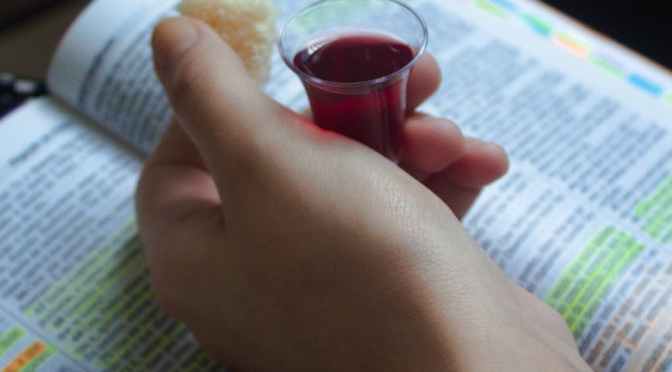
One Sunday, during the Lord’s Supper, the plate of unleavened bread was being passed down our pew when my then 3-year-old son loudly announced, “Dad, I want some!” Now, this was nothing new. He had been doing it for almost as long as he had been able to speak. But that day, my usual response of, “Son, this is just for Christians”, did not suffice. He fixed me with a very knowing and confident look for a toddler and declared, “Dad, I know it is just a cracker!”

Even though I later tried to explain these things to my little boy, he continued to believe we were trying to trick him and keep this little snack for ourselves. My son, in his innocence, could not grasp that the cup and the cracker represented something far more. He is not the only one who has struggled with this distinction. Adults can also lose sight of what the wafer and the cup signify.

It is not just a cracker, it is an emblem. While the bread and fruit of the vine do not become the body and blood of our Lord, as some falsely teach, we must never look at them as “common” things (Hebrews 10:29). They serve as powerful symbols that call to mind the death of the Lord. 

Christians partake of these emblems with these words in mind “this do in remembrance of Me” (Luke 22:19). “With just a morsel of bread and a few drops of grape juice, we draw our hearts back to Him who died for us.” (Christopher Stinnett). The Corinthian church once lost sight of this purpose and made a mockery of this act of worship. They failed to observe it as a memorial but instead turned it into a common feast, thus earning the Apostle’s rebuke, “For he who eats and drinks in an unworthy manner eats and drinks judgment to himself, not discerning the Lord’s body.” (1 Corinthians 11:29).

It is not just a cracker, it is an examination. Paul taught, “…whoever eats this bread or drinks this cup of the Lord in an unworthy manner will be guilty of the body and blood of the Lord. But let a man examine himself, and so let him eat of the bread and drink of the cup” (1 Corinthians 11:27-29). The Lord designed it to be a time, at the beginning of every week (Acts 20:7), for one to examine his or her life in relation to the Cross (James 4:8).  

It is not just a cracker, it is communion (1 Corinthians 10:16). Communion means fellowship or joint participation. Jesus indeed promised, “I will not drink of this fruit of the vine from now on until that day when I drink it new with you in My Father’s kingdom.” (Matthew 26:29. Cf. Lk 22:28-29). The church is His kingdom (Mark 9:1, Acts 2:47, Colossians 1:12-13). We must never forget that as we come together on the Lord’s day to partake of this memorial meal, Jesus is our unseen guest.

It is not just a cracker, it is a proclamationIn our observation of this memorial, we proclaim our faith in the saving power of Jesus’ death, burial, resurrection, and His future coming. Paul said, “For as often as you eat this bread and drink this cup, you proclaim the Lord’s death till He comes.” (1 Corinthians 11:26). 

No, it is not just a cracker and a bit of juice. It is so much more! It is a meal shared with our Lord, which looks backward to His death, inward in self-examination, and forward toward His future return.

WORSHIP OF ENTERTAINMENT? — BOB PRICHARD

There is no doubt that the man we know as Neil Postman described serious problems in modern culture in his insightful 1985 book Amusing Ourselves to Death. His thesis was that public discourse has been reshaped to such an extent by television and entertainment that thoughtful discourse is missing. Show business hype has affected advertising, politics, and religion. Postman’s conclusion is that none of these changes have made for improvement.

In our entertainment-oriented culture, many churches find themselves trying to out do themselves with more and more elaborate additions to worship. What began as special music by a choir becomes a full orchestra with professional soloists. A dramatic reading necessitates a full Broadway stage production. And as long as those who come to worship enjoy what is offered, anything goes. The expectation is that sermons will be shorter, wittier, and more uplifting. Anything in worship that cannot be “jazzed up” must be abandoned as boring-and there is nothing worse than being boring, we are led to believe.

The problem with this entertainment orientation is that the very object of worship is forgotten. God is the audience in worship. Jesus told the Samaritan woman that ignorant worship was unacceptable to God, even though it may have been sincere or enjoyable. “God is a Spirit: and they that worship him must worship him in spirit and in truth” (John 4:24). To worship God in spirit and truth means that worship must be from the heart, not just outward acts, and that it must be done in exact obedience to God’s commands. The worship must be directed to Him, not to the whims of the worshipers.

God’s regulations for worship as set out in the New Testament are neither boring nor out of date. They are God-centered, while entertainment is man-centered.

Cultural relevance is important-thus many churches are implementing modern technology such as projection systems to enhance sermons, and there is nothing wrong with the worshiper enjoying worship. God intended for worship to bless His children, but when worship is merely window dressing for an entertainment performance, it cannot please God. The apostle warned, “Whosoever transgresseth, and abideth not in the doctrine of Christ, hath not God” (2 John 1:9). Paul condemned things that “have an appearance of wisdom, with their self-imposed worship” (Colossians 2:23). “Self-imposed worship” is that worship fashioned after man’s desires. – Bob Prichard