
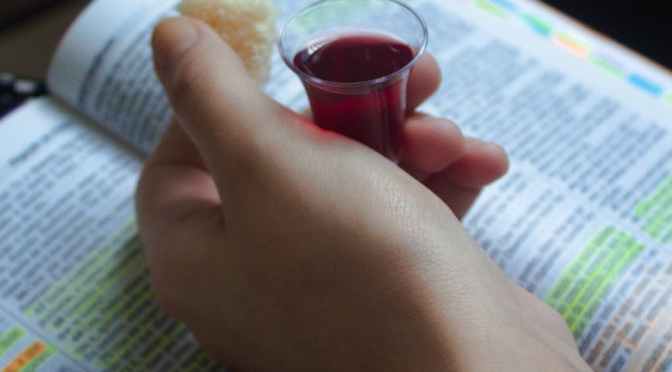
The question of who may partake of communion has long been controversial. Some religious groups practice “closed communion.” In “closed communion,” a person who is not a member of the particular church may not partake of communion. Some even go so far as to forbid other members of the religious group to participate if they are not members of that particular congregation. The alternative to “closed communion” is “open communion,” in which the individual decides whether he will partake of communion.
The idea of “closed communion” comes from the belief that church officials not only have the right, but the duty to see that they bar the unworthy from participating in the Lord’s Supper. The Lord’s Supper, however, is only one of the five acts of worship authorized in the New Testament. (The other acts of worship specified in the New Testament are singing, praying, giving, and teaching the Bible.) Since the Lord’s Supper is only one of these specified acts of worship commanded in the Bible, consistency would demand that the person barred from partaking of the Lord’s Supper should be barred from the other acts of worship.
Paul records Christ’s command to observe the Lord’s Supper: “For I have received of the Lord that which also I delivered unto you, That the Lord Jesus the same night in which he was betrayed took bread, And when he had given thanks, he brake it, and said, Take, eat: this is my body, which is broken for you: this do in remembrance of me. After the same manner also he took the cup, when he had supped, saying, This cup is the new testament in my blood: this do ye, as oft as ye drink it, in remembrance of me.” Paul then warns, “Wherefore whosoever shall eat this bread, and drink this cup of the Lord, unworthily, shall be guilty of the body and blood of the Lord. But let a man examine himself, and so let him eat of that bread, and drink of that cup. For he that eateth and drinketh unworthily, eateth and drinketh damnation to himself, not discerning the Lord’s body” (1 Corinthians 11:23-25, 27-29). The warning about partaking “unworthily” has confused many. “Unworthily” is an adverb, describing the manner of worship, not the worthiness of the worshiper.
Paul also states that each person is to “examine himself,” not to “examine his brother.” “Closed communion” makes a church, or its representatives the judge of a worshiper’s worthiness. But each must examine himself, and each who comes to worship must be “discerning the Lord’s body.” Paul said that Christ is the “head of the body, the church” (Colossians 1:18). Proper examination, and discerning of the Lord’s body would include asking oneself, “Have I done everything the Lord requires to add me to his body, the church?” and, “Am I sincere, with the right attitude of heart?”
No one has the right to “examine” another concerning the Lord’s Supper, forbidding him to participate. The Lord’s supper is for Christians. The one who partakes of the Lord’s Supper without properly examining himself, discerning the Lord’s body, and being willing to make the necessary changes, disobeys God. What we do in worship, and how we do it really matters! God has not left us to our own devices to decide how to worship Him!
 THE BIBLE MESSENGER