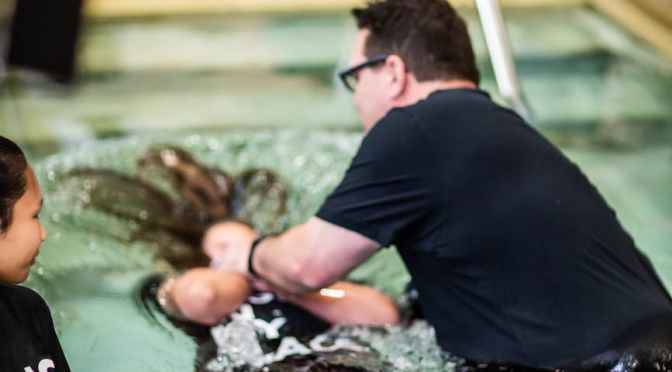
WHY WE MUST BE BURIED WITH CHRIST IN BAPTISM? — BOB PRICHARD

The heart of the gospel is the death, burial and resurrection of Christ. Paul began the great resurrection chapter, “Moreover, brethren, I declare unto you the gospel which I preached unto you, which also ye have received, and wherein ye stand; By which also ye are saved, if ye keep in memory what I preached unto you, unless ye have believed in vain. For I delivered unto you first of all that which I also received, how that Christ died for our sins according to the scriptures; And that he was buried, and that he rose again the third day according to the scriptures” (1 Corinthians 15:1-4).

It was their understanding that they had crucified the Son of God that made men at Pentecost cry out, “Men and brethren, what shall we do?” Peter’s response was “Repent, and be baptized every one of you in the name of Jesus Christ for the remission of sins, and ye shall receive the gift of the Holy Ghost” (Acts 2:36-38).

The baptism that Peter preached that day was the baptism preached in the early church. Paul reminded the Christians of Rome that he and they had both been baptized in the same way, for the same reasons. “Know ye not, that so many of us as were baptized into Jesus Christ were baptized into his death? Therefore we are buried with him by baptism into death: that like as Christ was raised up from the dead by the glory of the Father, even so we also should walk in newness of life” (Romans 6:3-4).

These verses speak of our baptism or burial into Christ, our clothing of ourselves in Him. “For as many of you as have been baptized into Christ have put on Christ” (Galatians 3:27).

I.  BECAUSE WE BELIEVE THE GOSPEL.

Our baptism pictures what we know to be true of Christ. As Jesus introduced the Lord’s Supper, He took bread and the cup and told them that his body and blood were given for us (Luke 22:19-20). We understand that Jesus suffered for us, “that he might sanctify the people with his own blood” (Hebrews 13:12).

We rejoice with the angels that said, “He is not here, but is risen: remember how he spake unto you when he was yet in Galilee, Saying, The Son of man must be delivered into the hands of sinful men, and be crucified, and the third day rise again” (Luke 24:6 -7). Every baptism proclaims the truth of the gospel.

II. BECAUSE HE IS OUR SUBSTITUTE.

He became one with us to be our substitute, because we cannot atone for our own sins. He “made himself of no reputation, and took upon him the form of a servant, and was made in the likeness of men: And being found in fashion as a man, he humbled himself, and became obedient unto death, even the death of the cross” (Philippians 2:7-8).

God “hath made him to be sin for us, who knew no sin; that we might be made the righteousness of God in him” (2 Corinthians 5:21). In baptism we acknowledge that we cannot atone for our own sins. Unless we accept His sacrifice, we must bear our own sins. “For the wages of sin is death; but the gift of God is eternal life through Jesus Christ our Lord” (Romans 6:23).

III. BECAUSE WE ARE DEAD IN SIN.

Baptism is a burial, and the man who is buried is dead. “For all have sinned, and come short of the glory of God” (Romans 3:23). What is dead needs to be buried (John 11:39).

As the head of the church, He gave Himself for the church, for us. “And he is the head of the body, the church: who is the beginning, the firstborn from the dead; that in all things he might have the preeminence” (Colossians 1:18). Buried with Him, we put the old man of sin to death.

IV. BECAUSE WE RISE TO WALK IN NEWNESS OF LIFE.

We have not suffered the true punishment of our sins. “For the wages of sin is death; but the gift of God is eternal life through Jesus Christ our Lord” (Romans 6:23). But Jesus Christ has suffered that punishment, and in our baptism we acknowledge and identify with Him in His suffering and death.

His death is our death to the old way of things. We know that God hates sin, because He was willing to see His only begotten son die for sins. “For God so loved the world, that he gave his only begotten Son, that whosoever believeth in him should not perish, but have everlasting life. For God sent not his Son into the world to condemn the world; but that the world through him might be saved” (John 3:16-17).

We are buried so that we may be alive in Him. “Yet a little while, and the world seeth me no more; but ye see me: because I live, ye shall live also” (John 14:19). That means that our perspective changes. “Set your affection on things above, not on things on the earth. For ye are dead, and your life is hid with Christ in God” (Colossians 3:2-3).

Every Christian should have the attitude of Paul: “I am crucified with Christ: nevertheless I live; yet not I, but Christ liveth in me: and the life which I now live in the flesh I live by the faith of the Son of God, who loved me, and gave himself for me” (Galatians 2:20).

“Therefore if any man be in Christ, he is a new creature: old things are passed away; behold, all things are become new” (2 Corinthians 5:17).

ARE THERE ANY LIVING APOSTLES TODAY? — BOB PRICHARD

During His ministry, Jesus had many men and women who followed Him. Among these were the twelve disciples (learners), whom we know as the twelve apostles. The word apostle comes from a Greek word meaning “a messenger, one who is sent forth.” Christ chose His apostles and sent them forth to carry the gospel message to the world. Although Jesus began with only twelve apostles, others became apostles, such as Matthias, who replaced Judas, and Paul, chosen by Christ. Although some claim that there is a need for apostles today, and that the apostleship is available to men today, the scriptures show that there is no one now living who can meet the qualifications, and there is no need for modern day apostles.

After Judas Iscariot betrayed Jesus and committed suicide, the remaining eleven apostles met to appoint a successor to Judas. Peter set out qualifications for the new apostle. “Wherefore of these men which have companied with us all the time that the Lord Jesus went in and out among us, Beginning from the baptism of John, unto that same day that he was taken up from us, must one be ordained to be a witness with us of his resurrection” (Acts 1:21-22). Certainly there is no person living today who walked with Jesus in that period from the baptism of John until His resurrection, or is an eyewitness to the resurrection.  

Paul was an exception to these qualifications, “as of one born out of due time” (1 Corinthians 15:8), but was appointed as an apostle by Christ. Christ appeared to Paul on the road to Damascus so that he could be an apostle and an eyewitness to the resurrection. Paul referred to this when he wrote the Corinthians, “Am I not an apostle? am I not free? have I not seen Jesus Christ our Lord? are not ye my work in the Lord?” (1 Corinthians 9:1). He also referred to this requirement for the apostleship, beginning the letter to the Galatians, “Paul, an apostle, (not of men, neither by man, but by Jesus Christ, and God the Father, who raised him from the dead)” (Galatians 1:1).

Jesus promised the apostles that the Holy Spirit would guide them into all truth (John 16:13), and told them to wait in Jerusalem to receive “power from on high” (Luke 24:49). God fulfilled this promise, as the apostles, baptized in the Holy Spirit, used their miraculous powers to preach the gospel on the day of Pentecost. According to Ephesians 4:5, there is one baptism today, which is water baptism. There will be no baptism of the Holy Spirit like what the apostles received available for modern man. Paul wrote, “Truly the signs of an apostle were wrought among you in all patience, in signs, and wonders, and mighty deeds” (2 Corinthians 12:12). Their miracles and signs proved that they were apostles. Only  the apostles could give the miraculous gifts to others, by the laying on of their hands. Acts 8 shows that Philip, although he personally possessed miraculous gifts, could not pass those gifts on to the people of Samaria, so it was necessary for the apostles to come to Samaria to give them spiritual gifts. The work of the apostles was to build up the church, and serve as eyewitnesses to the resurrection of Christ. They still serve that purpose today through the Bible, but not through any modern day apostles.

GOOD SOIL IN AMERICA — BOB PRICHARD

The world out of which the American Restoration movement grew was truly a world of “good soil” (Luke 8:8). The new nation was a nation that did not have allegiance to any particular religious denomination. Many were searching for truth in the early decades of the nineteenth century. It was fertile soil for people to question what they had always believed.

The result was a variety of religious movements. Joseph Smith offered his mythical Book of Mormon, as he suggested that all of the churches of the day were corrupt, and it was necessary to restore the church in those “latter days.” The “United Society of Believers in Christ’s Second Appearing,” better known as the Shakers, spread west to Kentucky and Indiana from their base at New Lebanon, NY, attracting thousands to communal living.

And then there was the Restoration Movement. From diverse beginnings, many began to question the religious division and denominational loyalties of their world. A trickle of searchers departing from those loyalties became a roaring river of people seeking to restore the ancient order of things. James O’Kelly left the Methodists. Elias Smith and Abner Jones left the Baptists. Barton W. Stone, Thomas Campbell and Alexander Campbell left the Presbyterians. Although these had some differences in doctrine, they united in understanding that the need was a return to the church of the New Testament, following only the Bible as a guide. As heirs of the Restoration Movement, we can be thankful that the religious climate of the nineteenth century provided the fertile soil of truth seekers.

We must seek good soil in our nation today. The moral climate of our world can’t help but convince truth seekers that there is a better way. “Thus saith the Lord, Stand ye in the ways, and see, and ask for the old paths, where is the good way, and walk therein, and ye shall find rest for your souls” (Jeremiah 6:16a).

DOES THE BIBLE OFFER HOPE FOR DEPRESSION? — BOB PRICHARD

Depression is perhaps the most common emotional problem that we face today. Experts suggest as many as one out of five Americans experience severe depression some time during their lives, and depression may be the most common health problem for women. Symptoms of depression include apathy, insomnia, difficulty in concentrating, and a general loss of interest in life. Severely depressed people may become suicidal, violent, or completely withdrawn. Depression has always been a problem for mankind. Bible characters such as King Saul, Elijah the prophet, Job, and others experienced depression.  

Sources of depression may be physical, psychological, or spiritual. Fatigue, chemical imbalances, and other physical problems may cause depression. After his defeat of the prophets of Baal and Asherah on Mount Carmel, Elijah was physically exhausted. When Jezebel threatened his life, he fled into the wilderness and was ready to die. The angel of the Lord comforted him and strengthened him with food, telling him, “Arise and eat; because the journey is too great for thee” (1 Kings 19:7). He still felt overwhelmed and alone, however. He said, “I have been very jealous for the LORD God of hosts: for the children of Israel have forsaken thy covenant, thrown down thine altars, and slain thy prophets with the sword; and I, even I only, am left; and they seek my life, to take it away” (1 Kings 19:10). He repeated,  “I, even I only, am left; and they seek my life, to take it away” (1 Kings 19:14). The Lord encouraged him by letting him know that there were still seven thousand faithful, and by sending Elisha to help him.

Loss is a common psychological cause of depression. Job lost his possessions, his family, his health, and even his reputation. He cried, “the thing which I greatly feared is come upon me, and that which I was afraid of is come unto me. I was not in safety, neither had I rest, neither was I quiet; yet trouble came” (Job 3:25-26). Later he learned that God continued to control the universe, saying “I know that thou canst do every thing, and that no thought can be withholden from thee” (Job 42:2). Unfulfilled hopes and dreams, and feelings of worthlessness or helplessness brought on by stress also cause depression. These feelings often come because a person has lost the proper perspective. Disappointments may be opportunities in disguise, however. They may be times to rearrange priorities, making our life priorities more in line with God’s will. It is helpful to remember when overwhelmed by feelings of helplessness and worthlessness to remember that God is still in control. He demonstrated His love in the cross. “God commendeth his love toward us, in that, while we were yet sinners, Christ died for us” (Romans 5:8).

Sin must have its spiritual consequences, which very often includes depression. Obedience to the Lord is the key. “If ye keep my commandments, ye shall abide in my love; even as I have kept my Father’s commandments, and abide in his love” (John 15:10). God does not intend for us to be depressed, and is eager to forgive and comfort. His love demonstrates this. A wise counselor points the depressed person to God.