DOES BAPTISM SAVE US OR DOES JESUS? — BOB PRICHARD

While shepherds were abiding in the field, the angel of the Lord appeared to them and said, “Fear not: for, behold, I bring you good tidings of great joy, which shall be to all people.  For unto you is born this day in the city of David a Saviour, which is Christ the Lord” (Luke 2:10-11). There is no doubt that the promised Savior is Jesus Christ. By His miracles and His resurrection from the dead, He showed convincingly that He was sent by the Father to be the Savior of mankind. Paul called Him “our Saviour Jesus Christ” (Titus 2:13), and Peter spoke of Jesus, saying, “Him hath God exalted with his right hand to be a Prince and a Saviour, for to give repentance to Israel, and forgiveness of sins” (Acts 5:31).

Jesus is the Savior. But Paul said, “we are saved by hope” (Romans 8:24), and “it pleased God by the foolishness of preaching to save them that believe” (1 Corinthians 1:21). Paul also said, “For by grace are ye saved through faith” (Ephesians 2:8). He advised Timothy, “Take heed unto thyself, and unto the doctrine; continue in them: for in doing this thou shalt both save thyself, and them that hear thee” (1 Timothy 4:16). James advised that we should “receive with meekness the engrafted [written] word, which is able to save your souls” (James 1:21). Thus we are saved by “hope,” by “preaching,” by “grace,” by receiving “the engrafted word,” and we even save ourselves and others by “taking heed” unto ourselves and “unto the doctrine.” The key is that our faith, our hope, and all of these other things must be in Christ, the Savior.

It is not surprising, then, that Peter said “the like figure whereunto even baptism doth also now save us,” which he explains is “(not the putting away of the filth of the flesh, but the answer of a good conscience toward God,) by the resurrection of Jesus Christ” (1 Peter 3:21). Even though Peter surely acknowledges that Jesus is the Savior, he also says that “baptism doth also now save us.” There is no contradiction between the ideas, however, when we realize that it is baptism which puts us into Jesus Christ, the Savior. “For as many of you as have been baptized into Christ have put on Christ” (Galatians 3:27).

 As He instituted the Lord’s Supper, Jesus told the disciples, “this is my blood of the new testament, which is shed for many for the remission of sins” (Matthew 26:28). Salvation and the remission, or forgiveness of sins come through His shed blood. We contact that saving blood, which was shed in His death, as we are buried with Him in baptism. Paul reminded the Roman Christians of their common experience in becoming Christians: “Know ye not, that so many of us as were baptized into Jesus Christ were baptized into his death? Therefore we are buried with him by baptism into death: that like as Christ was raised up from the dead by the glory of the Father, even so we also should walk in newness of life” (Romans 6:3-4). We are saved by baptism into the Savior Jesus Christ, just as we are saved by faith in Him. The fact that we must obey Him to accept His sacrifice makes Him no less the Savior.


WHY SHOULD OPPONENTS OF ABORTION IMPOSE THEIR MORALITY ON OTHERS? — BOB PRICHARD

On January 22, 1973, in its Roe v. Wade decision, the U. S. Supreme Court, by a 7 to 2 vote, ruled that the states could make no legal restrictions against abortion in the first three months of the mother’s pregnancy. In the second three months, restrictions could be applied only to make the procedure safer for the mother, and in the last three months, the state could enact legislation to protect “potential life” unless the health or life of the mother was in danger. The Court ruled that the unborn child was a non-person, not protected by the constitution. The decision made legal what was previously illegal in most states. The reversal of Roe v. Wade by the Supreme Court, on June 24, 2022, by a 6 to 3 decision, only moved the legal decision to the states, some of which allow abortion of the unborn child up to the moment of conception.

In considering if opponents of abortion should be able to impose their morality on those who believe abortion should remain legal, perspective comes by looking at another Supreme Court decision. In its Dredd Scott decision of March 5, 1857, by a 7 to 2 vote, the Supreme Court ruled that black people held as slaves were the property of their owners, and were non-persons, unprotected by the constitution. The ruling settled the issue that slavery was legal in the United States and protected by the constitution. Slavery opponents continued to work for its abolition however, because they believed it was morally wrong. Later Court decisions and the Civil War declared slavery illegal, and rightly recognized black people as persons protected by the constitution.

In reality, the legality of an issue has nothing at all to do with its morality. Christians recognize the authority of law. “Let every soul be subject unto the higher powers. For there is no power but of God: the powers that be are ordained of God. Whosoever therefore resisteth the power, resisteth the ordinance of God: and they that resist shall receive to themselves damnation.  For rulers are not a terror to good works, but to the evil” (Romans 13:1-3). The Lord expects us to be good citizens, subject to the government “not only for wrath, but also for conscience sake,” paying taxes and honoring those in authority (Romans 13:5-7).  

At the same time, however, Christians realize that their higher allegiance is to God, and not to human authority. Jesus said, “My kingdom is not of this world: if my kingdom were of this world, then would my servants fight, that I should not be delivered to the Jews: but now is my kingdom not from hence” (John 18:36). The higher calling of God is to value and protect human life. Paul wrote, “Thou shalt not commit adultery, Thou shalt not kill, Thou shalt not steal, Thou shalt not bear false witness, Thou shalt not covet; and if there be any other commandment, it is briefly comprehended in this saying, namely, Thou shalt love thy neighbour as thyself” (Romans 13:9). Surely the baby in its mother’s womb is a person who deserves not to be killed by abortion. From a legal standpoint, a child in the womb may be killed with impunity, but five minutes after birth it is considered murder to kill that child. Does the legal issue change the moral issue? Can anyone deny that the unborn child is human life?

TWO LEADERS/TWO DESTINIES — BOB PRICHARD

Both have devoted followers. Both have serious opposition from enemies who want them dead. Both are founders of world religions. How do they respond to these enemies?

If you are Muhammad, you raise an army of ten thousand to defend your city of Medina, fight your enemies, sacrifice the lives of your followers, and then occupy Mecca, the city of your enemies. You then teach a philosophy of  Jihad, or holy war, giving those you conquer the options of conversion, slavery, dhimmi status [second class with limited rights] or death.

If you are Jesus, you tell your enemies, “Verily, verily, I say unto you, He that heareth my word, and believeth on him that sent me, hath everlasting life, and shall not come into condemnation; but is passed from death unto life” (John 5:24).

If you are Jesus, when your enemies arrange for a small army to arrest you, and they tell you they are seeking Jesus of Nazareth, you protect your disciples and say, “Whom seek ye? And they said, Jesus of Nazareth. Jesus answered, I have told you that I am he: if therefore ye seek me, let these go their way” (John 18:7-8).

If you are Jesus, you don’t order your followers to fight a carnal battle: “My kingdom is not of this world: if my kingdom were of this world, then would my servants fight, that I should not be delivered to the Jews: but now is my kingdom not from hence” (John 18:36).

If you are Muhammad, when you die, you are buried in your tomb in Medina, and your body slowly decays away.

If you are Jesus, neither death nor the tomb can hold you. The angel told the women at the tomb, “Fear not ye: for I know that ye seek Jesus, which was crucified. He is not here: for he is risen, as he said. Come, see the place where the Lord lay” (Matthew 28:5-6).

Which leader do you want to follow?

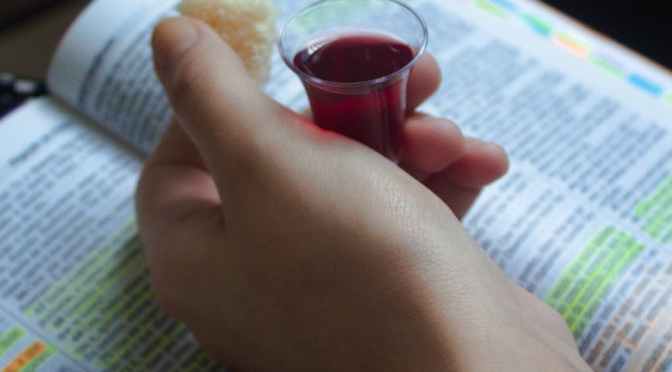
MUST I BE A MEMBER TO PARTAKE OF COMMUNION IN THE CHURCH OF CHRIST? — BOB PRICHARD

The question of who may partake of communion has long been controversial. Some religious groups practice “closed communion.” In “closed communion,” a person who is not a member of the particular church may not partake of communion. Some even go so far as to forbid other members of the religious group to participate if they are not members of that particular congregation. The alternative to “closed communion” is “open communion,” in which the individual decides whether he will partake of communion.

The idea of “closed communion” comes from the belief that church officials not only have the right, but the duty to see that they bar the unworthy from participating in the Lord’s Supper. The Lord’s Supper, however, is only one of the five acts of worship authorized in the New Testament. (The other acts of worship specified in the New Testament are singing, praying, giving, and teaching the Bible.) Since the Lord’s Supper is only one of these specified acts of worship commanded in the Bible, consistency would demand that the person barred from partaking of the Lord’s Supper should be barred from the other acts of worship.

Paul records Christ’s command to observe the Lord’s Supper: “For I have received of the Lord that which also I delivered unto you, That the Lord Jesus the same night in which he was betrayed took bread, And when he had given thanks, he brake it, and said, Take, eat: this is my body, which is broken for you: this do in remembrance of me. After the same manner also he took the cup, when he had supped, saying, This cup is the new testament in my blood: this do ye, as oft as ye drink it, in remembrance of me.” Paul then warns, “Wherefore whosoever shall eat this bread, and drink this cup of the Lord, unworthily, shall be guilty of the body and blood of the Lord. But let a man examine himself, and so let him eat of that bread, and drink of that cup. For he that eateth and drinketh unworthily, eateth and drinketh damnation to himself, not discerning the Lord’s body” (1 Corinthians 11:23-25, 27-29). The warning about partaking “unworthily” has confused many. “Unworthily” is an adverb, describing the manner of worship, not the worthiness of the worshiper.

Paul also states that each person is to “examine himself,” not to “examine his brother.” “Closed communion” makes a church, or its representatives the judge of a worshiper’s worthiness. But each must examine himself, and each who comes to worship must be “discerning the Lord’s body.” Paul said that Christ is the “head of the body, the church” (Colossians 1:18). Proper examination, and discerning of the Lord’s body would include asking oneself, “Have I done everything the Lord requires to add me to his body, the church?” and, “Am I sincere, with the right attitude of heart?”

No one has the right to “examine” another concerning the Lord’s Supper, forbidding him to participate. The Lord’s supper is for Christians. The one who partakes of the Lord’s Supper without properly examining himself, discerning the Lord’s body, and being willing to make the necessary changes, disobeys God. What we do in worship, and how we do it really matters! God has not left us to our own devices to decide how to worship Him!

WILL ALL OF THE DENOMINATIONS ENTER INTO THE KINGDOM OF GOD? — BOB PRICHARD

No. Although the sentiment, “Join the church of your choice” is very popular today, the current denominational system could not be pleasing to God. It is not possible for all of the denominations to enter into the kingdom of God because of the wide diversity of teaching among the multiplied hundreds of religious groups. While some teach that Jesus was the Son of God, others teach that He was really only a good teacher or prophet. Some teach the the Bible is sufficient for understanding the will of God, while others teach that there is a need for continuing modern revelations, or one must follow the teachings of other men and women such as Joseph Smith, or Ellen G. White. Some groups teach that baptism is essential to salvation, while others teach it is optional or entirely unnecessary. Some teach that baptism is immersion, others say it is sprinkling. All of these ideas cannot be right!

When Jesus was in the Garden of Gethsemane preparing to go to the cross, He prayed, “Neither pray I for these [the apostles] alone, but for them also which shall believe on me through their word; That they all may be one; as thou, Father, art in me, and I in thee, that they also may be one in us: that the world may believe that thou hast sent me” (John 17:20-21). The denominational system makes a mockery of this prayer, because it was the Lord’s will that all of His followers be united.

It is clear from reading Paul’s first letter to the church at Corinth that it was tragically divided by this denominational spirit. Some claimed to follow Paul, some claimed to follow Apollos, and others claimed to follow Peter. But Paul wrote to them, “Now I beseech you, brethren, by the name of our Lord Jesus Christ, that ye all speak the same thing, and that there be no divisions among you; but that ye be perfectly joined together in the same mind and in the same judgment” (1 Corinthians 1:10). The only way to be united is not by “agreeing to disagree,” or by saying that doctrine [the teachings of the church] just doesn’t matter, but by looking to the Bible as our only source of authority.

Some have thought that Jesus’ parable of the vine and the branches in John 15 is a description of the denominational world, with Jesus as the true vine and the various denominations as the branches coming from the true vine. But Jesus was addressing His disciples, not the denominations when He said, “I am the vine, ye are the branches” (John 15:5). He then said, “If a man abide not in me, he is cast forth as a branch, and is withered; and men gather them, and cast them into the fire, and they are burned” (John 15:6). It is the man who abides in Christ, not a denomination. 

If the branches were the various denominations, it would be a very strange vine. It would be like a vine that would bear grapes, watermelons, peaches, and apples, all at the same time. This cannot be! A “denomination” is just another word for division, and the Lord wishes that there be no divisions among those who profess faith in Him. Real unity among all people can come only by discarding denominational labels and doctrines, and following the pure revealed Word of God.