Category Archives: CHURCH

“THE WHEELBARROW IN THE GARAGE” — BOB PRICHARD

Traveling evangelist Billy Sunday (1862-1935) once said, “Going to church don’t make anybody a Christian, any more than taking a wheelbarrow into a garage makes it an automobile.” There is plenty of truth here. The land is filled with church-going people who are less than they should be. They claim to be Christians, but their lives don’t show it. In The Scarlet Letter, Nathaniel Hawthorne said that “No man, for any considerable period, can wear one face to himself, and another to the multitude, without finally getting bewildered as to which may be the true.” The hypocritical life eventually catches up with even the most skillful of hypocrites.

Just “going to church” will not make anyone a Christian, but neither does staying away from church make anyone any better. There are hypocrites at church each Sunday morning, but there are even bigger hypocrites staying home, pretending that what they are doing is more important than meeting with the saints for worship. Even if some of the saints seem more like “ain’ts,” why would anyone who claims to have any interest in the things of God not be in worship?

Hebrews 10:23-25 reminds us of our responsibilities in worship. “Let us hold fast the profession of our faith without wavering; (for he is faithful that promised;) And let us consider one another to provoke unto love and to good works: Not forsaking the assembling of ourselves together, as the manner of some is; but exhorting one another: and so much the more, as ye see the day approaching.” When we assemble together, we must consider one another by provoking to love and good works, as well as exhorting one another. Power words like “provoking” and “exhorting” indicates that this is serious business.

There’s more to the story, though. The verses immediately following in Hebrews 10 warn, “For if we sin wilfully after that we have received the knowledge of the truth, there remaineth no more sacrifice for sins, But a certain fearful looking for of judgment and fiery indignation, which shall devour the adversaries. He that despised Moses’ law died without mercy under two or three witnesses: Of how much sorer punishment, suppose ye, shall he be thought worthy, who hath trodden under foot the Son of God, and hath counted the blood of the covenant, wherewith he was sanctified, an unholy thing, and hath done despite unto the Spirit of grace?” (10:26-29). It is a serious thing to forsake the assembly of the saints!

AMUSING OURSELVES TO DEATH — BOB PRICHARD

Neil Postman described serious problems in modern culture in his insightful 1985 book Amusing Ourselves to Death. His thesis was that public discourse has been reshaped to such an extent by television and entertainment that thoughtful discourse has been replace by “show business: hype, affecting advertising, politics and religion. Postman’s conclusion was that none of these changes have made for improvement. And he wrote, of course, before the internet social media revolution.

The problem with the modern entertainment orientation in religion is that the very object of worship is forgotten. God, who created and commanded worship is the “audience” for worship. “God is a Spirit: and they that worship him must worship him in spirit and in truth” (John 4:24). To worship God in spirit and in truth means that worship is from the heart, not just outward acts, and that it is done in exact obedience to God’s commands. Worship must be directed to Him, not to whims and desires of the worshipers.

God’s regulations for worship as set out in the New Testament are neither boring nor out of date. They are God-centered, while modern entertainment innovations in worship are men-centered. The most often used words related to worship in the New Testament denote the concepts of bowing down or kissing toward deity, offering devotion and love. This is what our worship must include.

There is nothing wrong with the worshiper enjoying worship. God intended the blessings of worship for all His children. But when worship is merely the window dressing for an entertainment performance, it cannot be pleasing to God. The apostle warned, “Whosoever transgresseth, and abideth not in the doctrine of Christ, hath not God” (2 John 9). Paul condemned things that “have indeed a show of wisdom in will-worship” (Colossians 2:23). “Will-worship” is worship fashioned after man’s desires, which God must reject. Worshiping God in spirit and in truth is more important than catering to man’s desire for entertainment.

BEAUTIFUL HARMONY — BOB PRICHARD

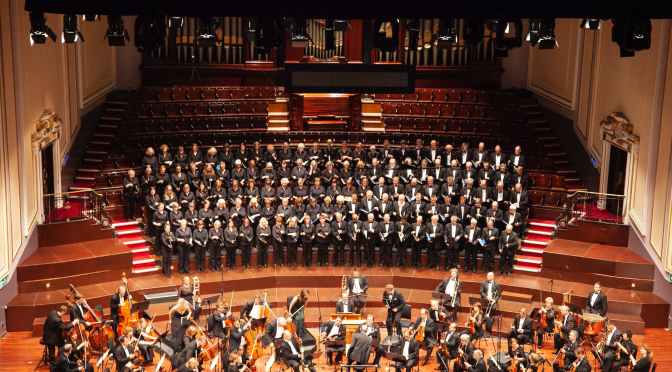
What cooperation! What unity! What harmony! I wish I was describing a congregation of God’s people, but instead, it was the Prague Symphony Orchestra. They performed in the  Knox Concert Series, and I had the chance to hear and see this great orchestra up close. The experience of hearing the orchestra reminded me anew about the importance of unity and cooperation.

The Prague Symphony Orchestra was composed of some 89 musicians, as well as a conductor, stage crew, etc. Almost a third of the musicians were violinists. It was interesting to see all of those bows moving in unison. Their skill was evident. This great skill means they used their God-given talents, and practiced endless hours. George Eliot said, “‘Tis God gives skill, But not without men’s hands: He could not make Antonio Stradivari’s violins without Antonio.” I wonder what we might accomplish in the Lord’s church if we were as diligent in honing our God-given talents and skills to be used in His service in the same way these musicians did.

All of the musicians were playing the same piece of music, and were “on the same page.” They were playing as individuals, under the direction of the conductor. As we follow Christ and scripture, we also work in unity and harmony.

From my vantage point in the concert, I could observe some of the musicians better than others. I was especially interested in the gentleman who played the tambourine during the first piece, Dvorak’s “Carnival Overture.” I never knew that anyone could be so enthusiastic playing the tambourine! It would seem this would not take as much skill as playing a violin, or a cello, or an oboe. Yet he played it with amazing energy and vigor, adding to the overall beauty of the piece, providing just the right accent needed. In the Lord’s work, there are often “parts” which seem minor─preparing the communion, counting the attendance, turning on the heat, etc., but think what a difference it makes when some of those “minor” jobs aren’t done as they should be.

As Paul reminded the Corinthians, “For the body is not one member, but many. If the foot shall say, Because I am not the hand, I am not of the body; is it therefore not of the body? And if the ear shall say, Because I am not the eye, I am not of the body; is it therefore not of the body? If the whole body were an eye, where were the hearing? If the whole were hearing, where were the smelling? But now hath God set the members every one of them in the body, as it hath pleased him. And if they were all one member, where were the body? But now are they many members, yet but one body” (1 Corinthians 12:14-20). We all have something to contribute to the Lord’s work, and we need everyone!

“Behold, how good and how pleasant it is for brethren to dwell together in unity!” (Psalm 133:1).

DOES IT REALLY MATTER WHAT WE DO IN WORSHIP IF WE ARE SINCERE? — BOB PRICHARD

Sincerity in worship is important, but it is not the only or most important thing in worship. It is common for religious people today to think that as long as they are sincere, and enjoy or find meaningful what they are doing, they can do almost anything in worship. This has led to many innovations into worship, as people seek newer and more exciting worship. Modern man’s fascination with new things is not necessarily in accord with God’s will, however. Worship is of utmost importance to God. He demonstrated how serious it is many times, but perhaps no clearer than in the story of Nadab and Abihu.

Nadab and Abihu were the two elder sons of Aaron, the first high priest of the Israelites as they made their way to the Promised Land. As sons of Aaron, they served as priests, and went into the very presence of God. “Then went up Moses, and Aaron, Nadab, and Abihu, and seventy of the elders of Israel:  And they saw the God of Israel: and there was under his feet as it were a paved work of a sapphire stone, and as it were the body of heaven in his clearness” (Exodus 24:9-10). They were leaders of the Israelite worship, and were in line to become the high priest upon Aaron’s death, but they lost their lives because they trifled with the worship of God (Numbers 3:4).

Moses described the death of Nadab and Abihu in Leviticus 10:1-2: “Nadab and Abihu, the sons of Aaron, took either of them his censer, and put fire therein, and put incense thereon, and offered strange fire before the LORD, which he commanded them not. And there went out fire from the LORD, and devoured them, and they died before the LORD.” Nadab and Abihu died because they “offered strange fire before the LORD, which he commanded them not.” They were priests, so they were the right people to lead the worship. They each had their censers used in worship, so they had the right implements to offer worship. They burned incense, which was a proper thing to do in worship. They were there at the tabernacle, the right place for worship. They were the right people, with the right implements of worship, doing the right thing, in the right place, but doing all of this in the wrong way, so God destroyed them! Even their father Aaron realized they had disobeyed God. “Then Moses said unto Aaron, This is it that the LORD spake, saying, I will be sanctified in them that come nigh me, and before all the people I will be glorified. And Aaron held his peace” (Leviticus 10:3). 

Nadab and Abihu received instant punishment from God for disobeying Him by doing what He had not commanded. They were probably very sincere, but they displeased God. Jesus called the scribes and Pharisees hypocrites because they cared more about what they wanted in worship than what God wanted. He condemned them, saying, “Ye hypocrites, well did Esaias prophesy of you, saying, This people draweth nigh unto me with their mouth, and honoureth me with their lips; but their heart is far from me. But in vain they do worship me, teaching for doctrines the commandments of men” (Matthew 15:7-9). If we add anything to our worship that God has not commanded, then we are offering the vain worship of disobedience.

DOES GOD APPROVE OF DENOMINATIONALISM? — BOB PRICHARD

Anyone who observes our religious world notices that it is filled with multiplied denominations. Many see this as a good thing—that anyone can find a denomination that teaches what he wants it to teach, thus the slogan, “Go to the church of your choice.”

This was the attitude expressed by Baptist preacher Charles Spurgeon in a sermon: “I bless God that there are so many denominations. If there were not men who differed a little in their creeds, we should never get as much gospel as we do. … God has sent different men to defend different kinds of truth.” Spurgeon’s Sermons, Vol. 2, 224. We might ask Mr. Spurgeon how there can be different kinds of truth. But on another occasion Mr. Spurgeon recognized the problem of denominations: “”Denominations! A plague upon denominationalism! There should be but one denomination: We should be denominated by the name of Christ, as a wife is named by her husband’s name. As long as the Church of Christ has to say, “My right arm is Episcopalian, and my left arm is Wesleyan, and my right foot is Baptist, and my left foot is Presbyterian or Congregational,” she is not ready for marriage. She will be ready when she has washed out these stains, when all her members have “one Lord, one faith, one baptism.”—Charles Haddon Spurgeon, Messages of Hope and Faith, p. 308.

The question is not whether Spurgeon approves of denominations, but whether God approves. Did God plan for man to “Go to the church of man’s choice”? Does God approve of our divided religious world?

Are religious divisions inevitable? Are all of the denominations in agreement with the fundamentals of the faith? Is it arrogant for anyone to claim that they understand the Bible and that others are in error? Can we know the truth?

Consider these facts about denominationalism.

1. Denominationalism is prompted by a spirit of separation.

Denomination is defined as “the act of naming, a name, an appellation.” The only way the word church is used in the New Testament is in the local sense—one congregation, or in the aggregate—the whole church. Any denomination is always more than the local congregation and less than the whole church, so it is based on separation. This is despite the Lord’s prayer that all of His followers would be united. In the very shadow of the cross, Christ prayed for unity. “Neither pray I for these alone [the apostles], but for them also which shall believe on me through their word [all who claim to be Christians today]; That they all may be one; as thou, Father, art in me, and I in thee, that they also may be one in us: that the world may believe that thou hast sent me” (John 17:20-21). The separation of denominationalism is a great detriment to the world believing the message of Christ.

2. Denominationalism sanctions the way of man’s choice (instead of God’s choice).

Jeremiah lamented, “O LORD, I know that the way of man is not in himself: it is not in man that walketh to direct his steps” (Jeremiah 10:23). Wayward man thinks he is making the right choice, but is too often mistaken. “There is a way that seemeth right unto a man, but the end thereof are the ways of death” (Proverbs 16:25). Remember, if it is up to man, he may pick the wrong church. The Lord will add a man to the right church, though. “And the Lord added to the church daily such as should be saved” (Acts 2:42b).

When the kingdom of Solomon divided into the two competing kingdoms of Israel and Judah, Jeroboam, who ruled the northern kingdom of Israel, realized that he might lose the people if they returned to Jerusalem to the temple, so he offered alternative worship. “Whereupon the king took counsel, and made two calves of gold, and said unto them, It is too much for you to go up to Jerusalem: behold thy gods, O Israel, which brought thee up out of the land of Egypt. And he set the one in Beth-el, and the other put he in Dan. And this thing became a sin: for the people went to worship before the one, even unto Dan.” (1 Kings 12:28-30). This was equivalent of “Attend the church of your choice.”

3. Denominationalism is built on sincerity instead of truth.

Sincerity is important, but is it enough? “And Paul, earnestly beholding the council, said, Men and brethren, I have lived in all good conscience before God until this day” (Acts 23:1). Paul was sincere, but sincerely wrong when he persecuted the church. “Who was before a blasphemer, and a persecutor, and injurious: but I obtained mercy, because I did it ignorantly in unbelief” (1 Timothy 1:13). Most of the people whose conversion we read of in the book of Acts, such as Lydia (Acts 16), and the Ethiopian treasurer (Acts 8), were very sincere in their beliefs. Why did they have to change? Would a sincere atheist need to change?

4. Denominationalism ignores God’s standard for unity.

Notice again the Lord’s prayer for unity. “Neither pray I for these alone, but for them also which shall believe on me through their word; That they all may be one; as thou, Father, art in me, and I in thee, that they also may be one in us: that the world may believe that thou hast sent me. And the glory which thou gavest me I have given them; that they may be one, even as we are one: I in them, and thou in me, that they may be made perfect in one; and that the world may know that thou hast sent me, and hast loved them, as thou hast loved me” (John 17:20-23).

Paul begged the Christians at Corinth to be united. “Now I beseech you, brethren, by the name of our Lord Jesus Christ, that ye all speak the same thing, and that there be no divisions among you; but that ye be perfectly joined together in the same mind and in the same judgment” (1 Corinthians 1:10).

Can you imagine Peter and Paul being members of different churches? Some say, “We are all teaching from the same Bible, going to the same place.” But how can one denomination say baptism is immersion, another say that it is sprinkling, and another say that it is pouring? “Can two walk together, except they be agreed?” (Amos 3:3).

5. Denominationalism destroys faith in the church.

Some say it doesn’t matter which church, if any, you are a member of. “One church is as good as another,” they say. But can any man build a church as good as the church Jesus built? The church Christ built came at great cost. Paul urged the Elders of the church at Ephesus, “Take heed therefore unto yourselves, and to all the flock, over the which the Holy Ghost hath made you overseers, to feed the church of God, which he hath purchased with his own blood” (Acts 20:28).

That church was established in Jerusalem on the first Pentecost after Christ was raised from the dead. Acts 2 tells the full story of how Peter and the other apostles preached the first gospel sermon to the multitudes gathered there, in fulfillment of Joel’s prophecy of the last days (Acts 2:14-21. Peter commanded, “Repent, and be baptized every one of you in the name of Jesus Christ for the remission of sins, and ye shall receive the gift of the Holy Ghost” (Acts 2:38). “Then they that gladly received his word were baptized: and the same day there were added unto them about three thousand souls” (Acts 2:41). “And the Lord added to the church daily such as should be saved” (Acts 2:47b).

You have the choice of being just a Christian. The appeal of the churches of Christ is to be a Christian, a member of the church of the New Testament, not a member of any denomination. If you obey the gospel just like they did in the book of Acts, worship like they did, and follow God’s commands as they did, you can be a member of the same church. The Lord does not want His followers to be divided among the denominations. He just wants us to be Christians, and Christians only. Why would you want to wear any other name religiously but that of Christian?

MORE THAN A CRACKER — JOSH ALLEN

One Sunday, during the Lord’s Supper, the plate of unleavened bread was being passed down our pew when my then 3-year-old son loudly announced, “Dad, I want some!” Now, this was nothing new. He had been doing it for almost as long as he had been able to speak. But that day, my usual response of, “Son, this is just for Christians”, did not suffice. He fixed me with a very knowing and confident look for a toddler and declared, “Dad, I know it is just a cracker!”

Even though I later tried to explain these things to my little boy, he continued to believe we were trying to trick him and keep this little snack for ourselves. My son, in his innocence, could not grasp that the cup and the cracker represented something far more. He is not the only one who has struggled with this distinction. Adults can also lose sight of what the wafer and the cup signify.

It is not just a cracker, it is an emblem. While the bread and fruit of the vine do not become the body and blood of our Lord, as some falsely teach, we must never look at them as “common” things (Hebrews 10:29). They serve as powerful symbols that call to mind the death of the Lord. 

Christians partake of these emblems with these words in mind “this do in remembrance of Me” (Luke 22:19). “With just a morsel of bread and a few drops of grape juice, we draw our hearts back to Him who died for us.” (Christopher Stinnett). The Corinthian church once lost sight of this purpose and made a mockery of this act of worship. They failed to observe it as a memorial but instead turned it into a common feast, thus earning the Apostle’s rebuke, “For he who eats and drinks in an unworthy manner eats and drinks judgment to himself, not discerning the Lord’s body.” (1 Corinthians 11:29).

It is not just a cracker, it is an examination. Paul taught, “…whoever eats this bread or drinks this cup of the Lord in an unworthy manner will be guilty of the body and blood of the Lord. But let a man examine himself, and so let him eat of the bread and drink of the cup” (1 Corinthians 11:27-29). The Lord designed it to be a time, at the beginning of every week (Acts 20:7), for one to examine his or her life in relation to the Cross (James 4:8).  

It is not just a cracker, it is communion (1 Corinthians 10:16). Communion means fellowship or joint participation. Jesus indeed promised, “I will not drink of this fruit of the vine from now on until that day when I drink it new with you in My Father’s kingdom.” (Matthew 26:29. Cf. Lk 22:28-29). The church is His kingdom (Mark 9:1, Acts 2:47, Colossians 1:12-13). We must never forget that as we come together on the Lord’s day to partake of this memorial meal, Jesus is our unseen guest.

It is not just a cracker, it is a proclamationIn our observation of this memorial, we proclaim our faith in the saving power of Jesus’ death, burial, resurrection, and His future coming. Paul said, “For as often as you eat this bread and drink this cup, you proclaim the Lord’s death till He comes.” (1 Corinthians 11:26). 

No, it is not just a cracker and a bit of juice. It is so much more! It is a meal shared with our Lord, which looks backward to His death, inward in self-examination, and forward toward His future return.

BEHIND THE MASK – BOB PRICHARD

An innovative treatment for traumatic brain injury and psychological health concerns at the National Intrepid Center of Excellence, part of Walter Reed National Military Medical Center, involves the injured service members creating masks, allowing them to illustrate hidden feelings. Common themes chosen include “death (often represented by skulls), inabililty to express themselves (mouths stitched, gagged, or locked shut), physical pain (facial wounds), and patriotic  feelings (American flags).” Some are resistant to the therapy, but several have found significant help. 

“I thought it was a joke,” recalled Sergeant Hopman. “I wanted no part of it because, number one, I’m a man, and I don’t like holding a dainty little paint brush. Number two, I’m not an artist. And number three, I’m not in kindergarten. Well, I was ignorant, and I was wrong, because it’s great. I think it’s great. I think this is what started me kind of opening up and talking about stuff and actually trying to get better.” (“Behind the Mask,” National Geographic, February 2015, p. 44).

The masks created in this program help injured service members reveal their pain within. I think, in conrast to them, that most of us create masks to hide what is within. We would hardly ever reveal the pain within our hearts to others.

But that is not how it should be in the family of God. “Be kindly affectioned one to another with brotherly love; in honour preferring one another; …  Rejoice with them that do rejoice, and weep with them that weep. Be of the same mind one toward another. Mind not high things, but condescend to men of low estate” (Romans 12:10, 15-16).

Paul also urges, “That there should be no schism in the body; but that the members should have the same care one for another. And whether one member suffer, all the members suffer with it; or one member be honoured, all the members rejoice with it. Now ye are the body of Christ, and members in particular” (1 Corinthians 12:25b-27).

Part of the glory of the New Jerusalem is that “God shall wipe away all tears from their eyes; and there shall be no more death, neither sorrow, nor crying, neither shall there be any more pain: for the former things are passed away” (Revelation 21:4). While we are in this life, however, we have our brothers and sisters in Christ to lift us up and care for us, to rejoice with us and to weep with us. 

IS THE CHURCH OF CHRIST A DENOMINATION? — BOB PRICHARD

A frequent follow-up question to “Are you a Christian?” is “What denomination are you?” “Denomination” is not found in the Bible, and the idea is based on sectarianism and division. “Denomination” is not simply an incidental name, but a choice to be divided from other believers who do not share the same sectarian doctrines. Religious denominations are divisions among people who may all claim to follow the same Lord and same Bible but cannot agree because of their denomination.

As Jesus prayed for His apostles before His arrest, He said, “Neither pray I for these alone, but for them also which shall believe on me through their word, that they all may be one, as thou Father art in me, and I in thee; that they also may be one is us, that the world may believe that thou hast sent me” (John 17:20-21). Jesus wanted unity among His apostles, and everyone who would believe the apostles’ teaching (whether through their preaching or writings). This unity is not possible as long as the denominational system exists.

The denominational system has developed with various creeds, manuals, handbooks, hierarchies, and systems of organization, which have grown more complex over time. Years ago many people understood that the denominational system was a violation of God’s will and sought to leave the denominations so that they could restore the “undenominational” church of Christ of the New Testament. By being just Christians, without being associated with any denomination, they believed they could better serve God. That is why the churches of Christ are undenominational. We have no creed but the Bible, no denominational or church hierarchy over the local congregation, and no authority for faith and practice other than the Bible. We are not “Church of Christ Christians,” but simply “Christians.”

“Seeds” of denominationalism were in the church at Corinth. Paul wrote, “It hath been declared unto me of you, my brethren, by them which are of the house of Chloe, that there are contentions among you. Now this I say, that every one of you saith, I am of Paul; and I of Apollos; and I of Cephas; and I of Christ” (I Cor. 1:11-12). Some were not satisfied to be Christians only, but wanted to be “Paulite Christians,” or “Apollosite Christians,” or “Cephasite Christians.” Paul asked, “Is Christ divided? Was Paul crucified for you? Or were you baptized in the name of Paul?” (1:13). They had divided the church into arguing factions. Paul emphasized the seriousness of the situation by saying he was glad he had only baptized a few at Corinth, so few could claim to follow him instead of Christ (1:14-16). Of what denomination were Peter and Paul? None! They were just Christians.

The church of Christ, if it truly is the church we read of in the New Testament, cannot be a denomination.

Why Are There So Many Churches? (World Video Bible School)

Contemporary religious scholars and historians estimate that there are approximately 38,000 denominations in the world today. Have you ever wondered if the true church still exists today? Does it really matter to which church I belong? If the true church does exist, how can I find it? Learn about the fascinating history of the first century church of the Bible and how it still exists today! Learn about God’s true church, the origins of denominationalism and God’s scheme of redemption for mankind.
Why Are There So Many Churches? from World Video Bible School on Vimeo.

Get a free pdf chart from WhyAreThereSoManyChurches.com