
WITH ONLY EIGHT ON THE ARK,  WHERE DID THE RACES COME FROM? — BOB PRICHARD

Genesis 7:13 gives us the census of people that were on the ark: “In the selfsame day entered Noah, and Shem, and Ham, and Japheth, the sons of Noah, and Noah’s wife, and the three wives of his sons with them, into the ark.” With these four men and four women, the earth was repopulated after the flood. Sin necessitated the flood. It was a time when “the earth also was corrupt before God, and the earth was filled with violence. And God looked upon the earth, and, behold, it was corrupt; for all flesh had corrupted his way upon the earth” (Genesis 6:11-12).

The Bible does not tell us when the races originated. It is possible that the races developed from the division of mankind at the tower of Babel, although Moses only says that God confounded their language and scattered them abroad (Genesis 11:1-9). As people scattered and separated, the races could have developed from the gene pool in each area. As people intermarried within a region, certain racial characteristics developed, as well as individual languages.

Modern science has tried to differentiate among the races, recognizing four basic races: Caucasoid, Mongoloid, Negroid and Australoid. The problem with these classifications, however, is that the dominant characteristics that are specific to a race, such as skin color or hair type, are found in the other racial groups. Skin color,  the most obvious racial characteristic, is determined primarily by the amount of melanin in the skin. Thus a “white” person may actually have darker skin than a “black” person. Although general racial characteristics may predominate among certain populations, all human beings are part of the same species, the human race.

We know that all human beings have come from the original man and woman, Adam and Eve, and also that all living human beings are descendants of Noah and his family. Paul declared that God “made of one every nation of men to dwell on all the face of the earth, having determined their appointed seasons, and the bounds of their habitation” (Acts 17:26 ASV). The words “of one,” literally mean “out of one male,” thus Adam. All mankind has descended from Adam.

Since all human beings have descended from the eight on the ark, then all racial characteristics must have been available in the genetic makeup of Noah and his family. Some suggest that Shem and his descendants were Asian, thus Mongoloid; Ham and his descendants were African, thus Negroid; and Japheth and his descendants were European, and thus Caucasoid. More likely, however, Noah and all of his family were a combination of all of our modern day races. The separation into current races was gradual over time.

Neither the biblical nor the non-biblical evidence supports the evolutionary theory, coming from racial prejudice, that the races descended from different primates or “prehuman” men. Since all races of humans can intermarry, all humans are interrelated, with the same ancestry in Adam and Eve.

ARM OF STONEWALL JACKSON — BOB PRICHARD

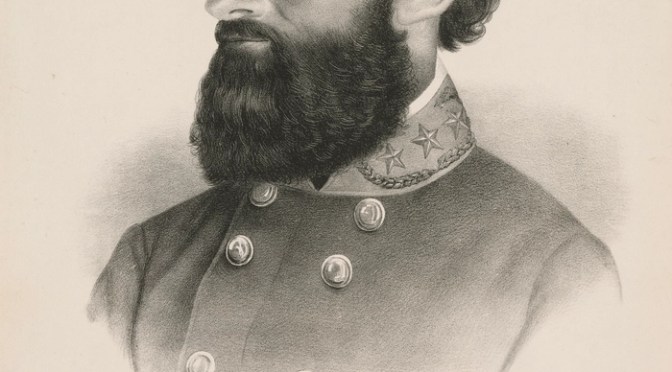
One of the more unusual Civil War monuments is found in a yard next to an Antebellum house near Chancellorsville, Virginia. The small stone bears the words, “Arm of Stonewall Jackson May 3 1863.”

Thomas Jonathan Jackson, was a teacher at the Virginia Military Institute at the outbreak of the Civil War, and was well known as a man of faith, and one who was loved by the enslaved people of Lexington because of his kindness and unceasing efforts for their moral instruction. He entered the Confederate army as a major, and quickly promoted to brigadier general. Because of the rigid steadiness of his troops at critical moments in the first battle of Bull Run, he was given the nickname of “Stonewall.”

His last battle, at Chancellorsville, was his greatest victory. After the battle, on the night of May 2, 1863, he was surveying his troops, when he was mistaken for federal cavalry and shot by his own troops. His injuries required the amputation of his left arm, which ordinarily would have been cremated. Because of the Confederate general’s popularity, however, the surgeon decided to bury it there at Chancellorsville. Jackson died seven days later, and was buried at Lexington, Virginia. Robert E. Lee said that the loss of Jackson was like the loss of his right arm.

His unusual death and burial raises questions. What will happen in the resurrection? Paul promises Christians: “Behold, I show you a mystery; We shall not all sleep, but we shall all be changed, In a moment, in the twinkling of an eye, at the last trump: for the trumpet shall sound, and the dead shall be raised incorruptible, and we shall be changed. For this corruptible must put on incorruption, and this mortal must put on immortality. So when this corruptible shall have put on incorruption, and this mortal shall have put on immortality, then shall be brought to pass the saying that is written, Death is swallowed up in victory” (1 Corinthians 15:51-54). God will take care of everything.

WHY DID PAUL TELL THE CORINTHIANS,  “I THANK GOD THAT I BAPTIZED NONE OF YOU”? — BOB PRICHARD

It seems strange that Paul would tell the Corinthians that he was thankful that he baptized none of them, when he taught more about the importance of baptism than any other New Testament writer. For example, he reminded the Roman Christians of their common experience of baptism into Christ: “Know ye not, that so many of us as were baptized into Jesus Christ were baptized into his death? Therefore we are buried with him by baptism into death: that like as Christ was raised up from the dead by the glory of the Father, even so we also should walk in newness of life” (Romans 6:3-4).

Most apparent contradictions in scripture are easily be explained by looking at the context (the surrounding verses). Problems filled the church in Corinth: abuses of the Lord’s Supper, abuses of miraculous spiritual gifts, problems concerning marriage, Christians taking one another before the law, and most importantly, divisions within the church. Jesus prayed for the unity of all of His followers: “That they all may be one; as thou, Father, art in me, and I in thee, that they also may be one in us: that the world may believe that thou hast sent me” (John 17:21). The church in Corinth, however, was dividing itself into sects and denominations.

Paul wrote, “Now I beseech you, brethren, by the name of our Lord Jesus Christ, that ye all speak the same thing, and that there be no divisions among you; but that ye be perfectly joined together in the same mind and in the same judgment” (1 Corinthians 1:10). Division was so severe, however, that some were saying “I am of Paul,” and others were saying “and I of Apollos; and I of Cephas; and I of Christ.” Paul asked, “Is Christ divided? was Paul crucified for you? or were ye baptized in the name of Paul?” (1 Corinthians 1:12-13). The divisions were so severe that they were no longer simply Christians, or followers of Christ, but they were becoming “Paulite Christians,” “Apollosite Christians,” and “Cephasite Christians.” They were not following Jesus as much as they were following the preachers who had taught or baptized them.

It was because of these terrible divisions that Paul said, “I thank God that I baptized none of you, but Crispus and Gaius; Lest any should say that I had baptized in mine own name. And I baptized also the household of Stephanas: besides, I know not whether I baptized any other. For Christ sent me not to baptize, but to preach the gospel: not with wisdom of words, lest the cross of Christ should be made of none effect. For the preaching of the cross is to them that perish foolishness; but unto us which are saved it is the power of God” (1 Corinthians 1:14-18). Paul did not want to contribute in any way to the divisions within the Corinthian congregation. He was glad there were very few Corinthians who could claim to be “Paulite Christians,” because he had only personally baptized a few. This is likely the reason that Jesus did not personally baptize.  “Jesus himself baptized not, but his disciples” (John 4:2). Paul preached the whole gospel of Christ, which includes water baptism.

WHAT DOES IT MEAN TO “OBEY THE GOSPEL”? — BOB PRICHARD

The gospel of Jesus Christ is the “good news” that mankind needs. It is a message that must be received and obeyed. Paul warned that the Loving Savior will return “In flaming fire taking vengeance on them that know not God, and that obey not the gospel of our Lord Jesus Christ” (2 Thessalonians 1:8). The Lord will take vengeance on those who “obey not the gospel,” and He will reward those who do obey the gospel.  

Paul stressed the fundamentals of the gospel, reminding the Corinthians what he had preached: “For I delivered unto you first of all that which I also received, how that Christ died for our sins according to the scriptures; And that he was buried, and that he rose again the third day according to the scriptures” (1 Corinthians 15:3-4). The death, burial, and resurrection of Christ were at the heart of his message. The rest of 1 Corinthians 15 is a discussion of the importance of the resurrection. He began the chapter by reminding the Corinthians that it was the gospel he had preached to them. “Moreover, brethren, I declare unto you the gospel which I preached unto you, which also ye have received, and wherein ye stand; By which also ye are saved, if ye keep in memory what I preached unto you, unless ye have believed in vain” (1 Corinthians 15:1-2). Paul stressed that the gospel is a message to receive, and to stand in, and it is a message that brings salvation when kept in memory.

Paul asserts that we choose the master we serve. “Know ye not, that to whom ye yield yourselves servants to obey, his servants ye are to whom ye obey; whether of sin unto death, or of obedience unto righteousness?” (Romans 6:16). The master we choose is the one we obey. Jesus said, “If ye love me, keep my commandments” (John 14:15). Paul commended the Romans for the choice they had made in obeying Christ and His gospel. “But God be thanked, that ye were the servants of sin, but ye have obeyed from the heart that form of doctrine which was delivered you. Being then made free from sin, ye became the servants of righteousness” (Romans 6:17-18). They had obeyed from the heart “that form of doctrine” he had delivered to them. Doctrine refers to something taught, and Paul taught the same gospel wherever he went. Centered in the facts of the death, burial and resurrection of Christ, his message was one of the necessity of obeying the will of God and becoming a servant of righteousness.  

Earlier he stressed that they were buried with Christ in baptism to obey the gospel. “Know ye not, that so many of us as were baptized into Jesus Christ were baptized into his death? Therefore we are buried with him by baptism into death: that like as Christ was raised up from the dead by the glory of the Father, even so we also should walk in newness of life” (Romans 6:3-4). Baptism parallels the death, burial, and resurrection of Christ. Man is dead in sin, and then buried with Christ in baptism. He rises from the waters of baptism in the likeness of Christ’s resurrection to walk in newness of life. He then has the forgiveness of sin, and the joy that comes from obeying the gospel.

I AM NOT A VICTIM! — BOB PRICHARD

Under the title, “We’re All Victims,” John Leo wrote about the top 10 “victim stories” of the year, in the November 21, 2005 U.S.News. Leo pointed out that in our politically correct culture, anyone who gets offended is a victim. Leo cited the British Muslims who were “victimized” by tissue boxes picturing Winnie the Pooh and Piglet; and atheists who were “victimized” by actors who thanked God for winning Oscars, as well as students at the University of Wisconsin who were “victimized” by local bars that discontinued discount drinks on weekends in response to a federal campaign to limit binge drinking.

The dictionary defines a victim as “one who is harmed or killed by another; one who is harmed by or made to suffer from an act, circumstance, agency, or condition; a person who is tricked, swindled, or taken advantage of.” 

Yes, everywhere we look, we see victims. But I want you to know that I am not a victim. In fact, I am guilty. I know the truth of Paul’s words in Romans 3:23: “For all have sinned, and come short of the glory of God.” I know that I am a sinner, deserving of God’s punishment. But I know that I will not receive justice for my sins, but instead God’s grace.

“Being justified freely by his grace through the redemption that is in Christ Jesus” (Romans 3:24), reminds me that I have been forgiven through the grace of God when I obeyed the gospel of Christ.

“Then Peter said unto them, Repent, and be baptized every one of you in the name of Jesus Christ for the remission of sins, and ye shall receive the gift of the Holy Ghost” (Acts 2:38). Because I have repented and been baptized, my sins have been remitted.

One more definition of victim: “a living creature slain and offered as a sacrifice during a religious rite.” I am so grateful that Jesus served as that victim for me so that I could have forgiveness.