
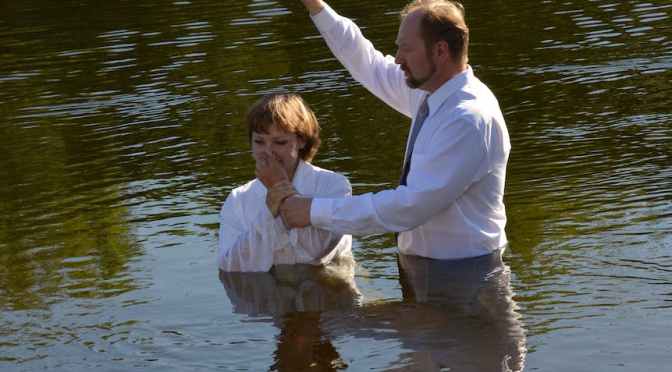
Strictly speaking, scriptural baptism is a “one time” proposition. Ephesians 4:5 says that there is “one baptism” today. The “one baptism” consists of the immersion of a penitent believer in water, whereby he contacts the blood of Christ, receives the forgiveness of his sins, and the Lord adds him to the church. Even if a person “backslides,” or becomes unfaithful, it is not necessary to be rebaptized, if his original baptism was a scriptural baptism. Simon the sorcerer, in Acts 8, is an example of a Christian who sinned, and was told to pray for forgiveness. Peter told Simon, “Repent therefore of this thy wickedness, and pray God, if perhaps the thought of thine heart may be forgiven thee” (Acts 8:22). Philip the evangelist had properly taught and baptized Simon, so there was no need for him to be rebaptized (Acts 8:13).
Sometimes, however, when a person thinks he is being scripturally baptized, he is really doing no more than getting wet. After further Bible study, he may realize he was not baptized according to the scriptures. Several conditions call for a person who has received “another baptism” to be baptized into Christ. Nearly every religious group practices some form of baptism. But if that baptism is not the “one baptism” of Ephesians 4:5, then it is not a scriptural baptism. For instance, if a person has only been sprinkled with water, and has not been immersed, or “buried with him by baptism into death” (Romans 6:4), then when he realizes the proper mode of baptism is immersion into Christ, he should be “rebaptized.”
Also, baptism that follows salvation, to join a man-made religious body, is not the “one baptism.” Peter said to the multitude on Pentecost, “Repent and be baptized every one of you in name of Jesus Christ for the remission of sins” (Acts 2:38). The three thousand who obeyed that day, as others of the New Testament, received the remission, or forgiveness of their sins, after baptism. Sectarian baptism, even if by immersion, cannot be the “one baptism” if the person thinks that he has already received the forgiveness of his sins, and is thus saved, before his baptism. The purpose for baptism makes a difference! Scriptural baptism puts one into the church, the body of Christ, which He has promised to save. “For by one Spirit are we all baptized into one body” (1 Corinthians 12:13).
Often mature believers who committed their lives to Christ and were baptized at an early age begin to question whether they properly understood what they were doing when baptized. If the person was old enough to understand that he was obeying Christ by being immersed, receiving the forgiveness of his sins, and making Christ the Lord of his life, then he understood enough. It is only natural that as one grows in his understanding of the scriptures, he will realize that there was much he did not understand when he first became a Christian. If there is doubt in a person’s mind, however, concerning his baptism, then he should take action to remove that doubt. The Master said, “If ye love me, keep my commandments” (John 14:15).
 THE BIBLE MESSENGER