IS PROVERBS 22:6 A GUARANTEE TO FAITHFUL PARENTS? — BOB PRICHARD

Solomon said, “Train up a child in the way he should go: and when he is old, he will not depart from it” (Proverbs 22:6). These words bring comfort to many parents who understand that the difficult task of parenting will  be rewarded by faithful children, but there are many parents who are filled with guilt and anguish because their children have gone astray, despite their best efforts. Solomon’s words are simple enough, but they just don’t always seem to come true! All too often godly men and women try with all of their ability to be good parents, but still fail. But it must be understood that Proverbs 22:6 is a proverb, not a promise. A proverb is a general statement of a rule, which may have exceptions. Those “exceptions to the rule” cause heartache.  

Implied in “train up a child in the way he should go” are the concepts of providing real training, and knowing “the way he should go.” Sadly, many parents have no concept of “training up a child.” They do little or nothing to provide the necessary spiritual food their children need.  While they may demand that the church train their children spiritually, they see no need to do this themselves as parents. The word here translated as “train up” is used elsewhere in scripture to mean dedicating something or someone to God’s service, as in 1 Kings 8:63, where “the king and all the children of Israel dedicated the house of the LORD.” Thus Solomon urges all parents to dedicate and train their children for service.

“In the way he should go” literally means “according to his way.” That is, the training or dedication of the child should be according to his natural personal inclination, abilities, age, and qualifications. The idea of “the way he should go” is not so much the way the parent wants him to go, but the way the child should go so as to maximize his talents in service to God. To actually know “the way he should go” implies that the parent will spend a great deal of time learning the needs, desires, and capabilities of the child. To fulfill the proverb requires tremendous commitment.

That investment of the time, energy, and knowledge necessary for each child is worthwhile, though, because “when he is old, he will not depart from it.” The parent who has made the proper investment of training up the child in the way he should go will know that the child has been properly prepared to live wisely before God.

But what about the child who strays. Have the parents failed? Sadly, many times parents do fail. But just as often, the child that goes astray does so because he exercises his own free will to disobey. Many godly men and women, such as the prophet Samuel, lost their children because their children chose to follow the way of the world.

CAN THE AVERAGE PERSON REALLY UNDERSTAND THE BIBLE? — BOB PRICHARD

Yes! Numerous passages of scripture are directly addressed to the common person. “Husbands, love your wives … Wives, submit yourselves unto your own husbands … Children, obey your parents in the Lord” (Ephesians 5:25, 22; 6:1). “I write unto you, little children … I write unto you, fathers … I write unto you, young men” (1 John 2:12-13). The Bible is God’s message to humanity. All will be judged according to the Bible, so a God of Justice would not require mankind to understand the un-understandable.

The Bible’s longest chapter is filled with praise for God’s written Word, indicating that He wants and expects the individual to understand. “The entrance of thy words giveth light; it giveth understanding unto the simple” (Psalm 119:130). The Bible is for the “simple,” not just religious authorities. “I have more understanding than all my teachers: for thy testimonies are my meditation” (verse 99).  It is not through the precepts of men, or their interpretations, but through God’s precepts that we gain understanding:  “I understand more than the ancients, because I keep thy precepts. … Through thy precepts I get understanding: therefore I hate every false way” (verses 100, 104).

Paul told the church at Corinth, “we write none other things unto you, than what ye read or acknowledge” (2 Corinthians 1:13). The modern language NIV renders his  words, “we do not write you anything you cannot read or understand.” Although Paul had written the Corinthians about difficult subjects such as church discipline, spiritual gifts, marriage, and the resurrection, he still expected them to read and understand. In similar fashion, he wrote to the church at Ephesus, “by revelation he made known unto me the mystery; (as I wrote afore in few words, whereby, when ye read, ye may understand my knowledge in the mystery of Christ)” (Ephesians 3:3-4). Paul’s readers could have the same insight into the (no longer hidden) mystery that had been revealed to him in Christ.

As long as people do not believe they can understand the Bible, and refuse to study it for themselves, they will not understand. The key is to put into practice what we do understand! The deepest understanding of God’s Will comes when through study we are “those who by reason of use have their senses exercised to discern both good and evil” (Hebrews 5:14). If the average person cannot really understand the Bible without another intervening to teach, then it means that the God Who created the universe was not able to make Himself understood through the Word. If the average man cannot trust his own understanding, how can he trust another man’s understanding? 2 Peter 1:19-21, written to Christians, says that  “no prophecy of the scripture is of any private interpretation. For the prophecy came not in old time by the will of man: but holy men of God spake as they were moved by the Holy Ghost.”  Peter did not say that  no individual can understand, but that the prophets spoke under the inspiration of the Holy Ghost, revealing God’s message, rather than their own. “Let my cry come near before thee, O LORD: give me understanding according to thy word” (Psalm 119:169).  You can understand the Bible!

WHEN SHOULD A PERSON BE “REBAPTIZED”? — BOB PRICHARD

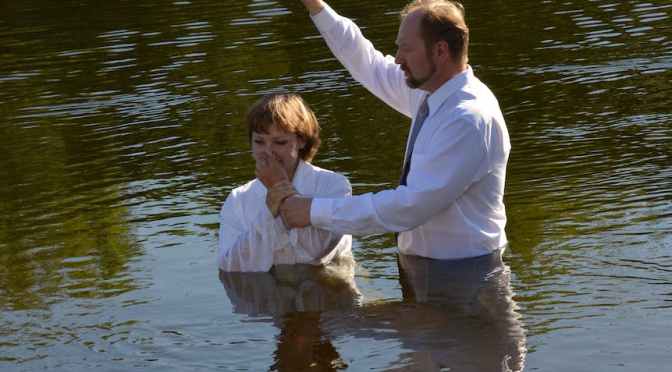
Strictly speaking, scriptural baptism is a “one time” proposition. Ephesians 4:5 says that there is “one baptism” today. The “one baptism” consists of the immersion of a penitent believer in water, whereby he contacts the blood of Christ, receives the forgiveness of his sins, and the Lord adds him to the church. Even if a person “backslides,” or becomes unfaithful, it is not necessary to be rebaptized, if his original baptism was a scriptural baptism. Simon the sorcerer, in Acts 8, is an example of a Christian who sinned, and was told to pray for forgiveness. Peter told Simon, “Repent therefore of this thy wickedness, and pray God, if perhaps the thought of thine heart may be forgiven thee” (Acts 8:22). Philip the evangelist had properly taught and baptized Simon, so there was no need for him to be rebaptized (Acts 8:13).

Sometimes, however, when a person thinks he is being scripturally baptized, he is really doing no more than getting wet. After further Bible study, he may realize he was not baptized according to the scriptures. Several conditions call for a person who has received “another baptism” to be baptized into Christ. Nearly every religious group practices some form of baptism. But if that baptism is not the “one baptism” of Ephesians 4:5, then it is not a scriptural baptism. For instance, if a person has only been sprinkled with water, and has not been  immersed, or “buried with him by baptism into death” (Romans 6:4), then when he realizes the proper mode of baptism is immersion into Christ, he should be “rebaptized.”

Also, baptism that follows salvation, to join a man-made religious body, is not the “one baptism.” Peter said to the multitude on Pentecost, “Repent and be baptized every one of you in name of Jesus Christ for the remission of sins” (Acts 2:38). The three thousand who obeyed that day, as others of the New Testament, received the remission, or forgiveness of their sins, after baptism. Sectarian baptism, even if by immersion, cannot be the “one baptism” if the person thinks that he has already received the forgiveness of his sins, and is thus saved, before his baptism. The purpose for baptism  makes a difference! Scriptural baptism puts one into the church, the body of Christ, which He has promised to save. “For by one Spirit are we all baptized into one body” (1 Corinthians 12:13).

Often mature believers who committed their lives to Christ and were baptized at an early age begin to question whether they properly understood what they were doing when baptized. If the person was old enough to understand that he was obeying Christ by being  immersed, receiving the forgiveness of his sins, and making Christ the Lord of  his life, then he understood enough. It is only natural that as one grows in his understanding of the scriptures, he  will realize that there was much he did not understand when he first became a Christian. If there is doubt in a person’s mind,  however, concerning his baptism, then he should take action to remove that doubt. The Master said, “If ye love me, keep my commandments” (John 14:15).