Tag Archives: Unity

SINCE THERE IS ONLY ONE GOD, WHY ISN’T THERE JUST ONE CHURCH? — BOB PRICHARD

Paul tells us explicitly that there is “One God and Father of all, who is above all, and through all, and in you all” (Ephesians 4:6). Most people have little trouble with this concept, understanding that our Heavenly Father created our world and loved us enough to send Christ to save us from our sins. Paul does not speak only of  “One God,” however, but mentions seven “unities.” “There is one body, and one Spirit, even as ye are called in one hope of your calling;  One Lord, one faith, one baptism, One God and Father of all, who is above all, and through all, and in you all” (Ephesians 4:4-6). The first of the seven unities Paul mentions is “one body.”    

At the end of the first chapter of the letter to the Ephesians, Paul explained that because Christ obeyed the Father and conquered death, that God “hath put all things under his feet, and gave him to be the head over all things to the church, Which is his body, the fulness of him that filleth all in all” (Ephesians 1:22-23). The church is defined as His body, the “one body” that Paul mentioned in Ephesians 4:4. This is just what we would expect, one head connected with one body. Our religious world today, however, presents a monstrosity to God, with many churches or bodies claiming to be attached to the one head, Jesus Christ.

The Lord’s desire from the beginning was that all of His followers would be united in His church. As He prepared for the cross, Jesus prayed for His disciples, and then said, “Neither pray I for these alone, but for them also which shall believe on me through their word; That they all may be one; as thou, Father, art in me, and I in thee, that they also may be one in us: that the world may believe that thou hast sent me. And the glory which thou gavest me I have given them; that they may be one, even as we are one: I in them, and thou in me, that they may be made perfect in one; and that the world may know that thou hast sent me, and hast loved them, as thou hast loved me” (John 17:20-23). Jesus understood that the unity (or disunity) of His followers would be a powerful witness to the world. Surely the disunity of the current denominational system hinders the spread of the gospel of Christ.

Paul warned the Corinthians against disunity, as they began to follow various preachers, forgetting Christ. “Now I beseech you, brethren, by the name of our Lord Jesus Christ, that ye all speak the same thing, and that there be no divisions among you; but that ye be perfectly joined together in the same mind and in the same judgment. For it hath been declared unto me of you, my brethren, by them which are of the house of Chloe, that there are contentions among you. Now this I say, that every one of you saith, I am of Paul; and I of Apollos; and I of Cephas; and I of Christ. Is Christ divided? was Paul crucified for you? or were ye baptized in the name of Paul?” (1 Corinthians 1:10-13). Jesus promised Peter and the disciples, “I will build my church” (Matthew 16:18). He did not promise to build the many denominational bodies we see today, but His church. The way to be a member of His church today is to reject the creeds, manuals, and catechisms of the denominations, and just be Christians, wearing the name of Christ. This is the plea of the churches of Christ.

IF THERE IS ONE GOD, WHY NOT ONE CHURCH? — BOB PRICHARD

Paul wrote that there is “One God and Father of all, who is above all, and through all, and in you all” (Ephesians 4:6). Most people have little trouble with this idea, understanding that our Heavenly Father created our world and loved us enough to send Christ. Paul also mentions six other “unities.” “There is one body, and one Spirit, even as ye are called in one hope of your calling; One Lord, one faith, one baptism, One God and Father of all, who is above all, and through all, and in you all” (Ephesians 4:4-6). The first of the seven unities Paul mentions is “one body.”    

Paul explained that because Christ obeyed the Father and conquered death, that God “hath put all things under his feet, and gave him to be the head over all things to the church, Which is his body, the fulness of him that filleth all in all” (Ephesians 1:22-23). The church is His body, the “one body” that Paul mentioned in Ephesians 4:4. This is just what we would expect—one head connected with one body. Today’s religious world, however, presents a monstrosity to God, with many churches or bodies claiming to be attached to the one head, Jesus Christ.

The Lord’s desire from the beginning was for the unity of His followers in His church. As He prepared for the cross, Jesus prayed for His disciples, and then said, “Neither pray I for these alone, but for them also which shall believe on me through their word; That they all may be one; as thou, Father, art in me, and I in thee, that they also may be one in us: that the world may believe that thou hast sent me. And the glory which thou gavest me I have given them; that they may be one, even as we are one: I in them, and thou in me, that they may be made perfect in one; and that the world may know that thou hast sent me, and hast loved them, as thou hast loved me” (John 17:20-23). Jesus understood that the unity (or disunity) of His followers would be a powerful witness to the world. Surely the disunity of the current denominational system hinders the spread of the gospel of Christ.

Paul warned the Corinthians against disunity. “Now I beseech you, brethren, by the name of our Lord Jesus Christ, that ye all speak the same thing, and that there be no divisions among you; but that ye be perfectly joined together in the same mind and in the same judgment. For it hath been declared unto me of you, my brethren, by them which are of the house of Chloe, that there are contentions among you. Now this I say, that every one of you saith, I am of Paul; and I of Apollos; and I of Cephas; and I of Christ. Is Christ divided? was Paul crucified for you? or were ye baptized in the name of Paul?” (1 Corinthians 1:10-13). Jesus promised Peter and the disciples, “I will build my church” (Matthew 16:18). He did not promise to build the many denominational bodies we see today, but His church. The way to be a member of His church today is to reject the creeds, manuals, and catechisms of the denominations, and just be a Christian, wearing the name of Christ. This is the plea of the churches of Christ.

CAN WE BE ONE? — BOB PRICHARD

As Jesus was preparing to face the cross, He went to the Garden of Gethsemane to pray fervently for the disciples, knowing that they would face difficulty in sharing His message of peace and love with the world. Having prayed for the disciples, he also prayed for Christians down through the ages:  Neither pray I for these alone, but for them also which shall believe on me through their word; That they all may be one; as thou, Father, art in me, and I in thee, that they also may be one in us: that the world may believe that thou hast sent me” (John 17:20-21). His prayer was that all who would believe in Him through the word of the apostles would have the same unity that He experienced with the Father. Sadly, men seek disunity and division, ignoring Christ’s prayer. The consequence of this is that many have rejected the gospel of Christ because of the divisions they see within “Christendom.”

In Paul’s day there was “one body, and one Spirit, even as ye are called in one hope of your calling; one Lord, one faith, one baptism, one God and Father of all” (Ephesians 4:4-6). Yet men today claim there are many bodies and many faiths. Most claim to be what might be called “hyphenated Christians.” A person who is a “denominational-Christian” is subject to the creeds, handbooks and bylaws of his denomination. Why not give up the denominational names and creeds? Why not just be Christians, not members of any denomination? 

Lasting unity among the followers of Christ can come only one way⎯by going back to the  Bible and  throwing out the creeds, manuals, and man-made traditions. Paul wrote to a very divided congregation at Corinth, pleading with them to have real Christian unity. “Now I beseech you, brethren, by the name of our Lord Jesus Christ, that ye all speak the same thing, and that there be no divisions among you; but that ye be perfectly joined together in the same mind and in the same judgment” (1 Corinthians 1:10). They could only find unity by being “perfectly joined together in the same mind and in the same judgment.”  Christians can have this unity of mind and judgmentonly by uniting in the teaching of the Bible, the Word of God. Creeds and handbooks can never bring unity.

Sometimes there are unity or “ecumenical” movements among the churches, and some good may be accomplished by these groups banding together for a common cause. There is usually agreement however, that doctrine will be forgotten or overlooked, or else how can one group that teaches baptism is immersion get along with another group that teaches baptism is sprinkling, etc.? Is this really being joined together in the same mind and in the same judgment? If they will not agree on the Bible, how can God’s people agree on anything?  

The Bible is not a dead letter from two thousand years ago. It is “quick, and powerful, and sharper than any twoedged sword, piercing even to the dividing asunder of soul and spirit, and of the joints and marrow, and is a discerner of the thoughts and intents of the heart” (Hebrews 4:12). The Bible, and the Bible alone must be followed for unity today.

BEAUTIFUL HARMONY — BOB PRICHARD

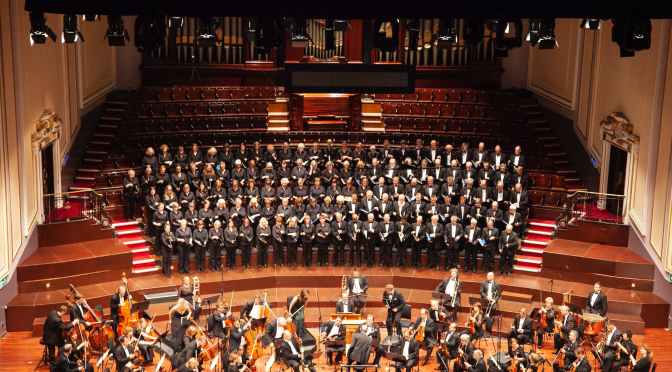
What cooperation! What unity! What harmony! I wish I was describing a congregation of God’s people, but instead, it was the Prague Symphony Orchestra. They performed in the  Knox Concert Series, and I had the chance to hear and see this great orchestra up close. The experience of hearing the orchestra reminded me anew about the importance of unity and cooperation.

The Prague Symphony Orchestra was composed of some 89 musicians, as well as a conductor, stage crew, etc. Almost a third of the musicians were violinists. It was interesting to see all of those bows moving in unison. Their skill was evident. This great skill means they used their God-given talents, and practiced endless hours. George Eliot said, “‘Tis God gives skill, But not without men’s hands: He could not make Antonio Stradivari’s violins without Antonio.” I wonder what we might accomplish in the Lord’s church if we were as diligent in honing our God-given talents and skills to be used in His service in the same way these musicians did.

All of the musicians were playing the same piece of music, and were “on the same page.” They were playing as individuals, under the direction of the conductor. As we follow Christ and scripture, we also work in unity and harmony.

From my vantage point in the concert, I could observe some of the musicians better than others. I was especially interested in the gentleman who played the tambourine during the first piece, Dvorak’s “Carnival Overture.” I never knew that anyone could be so enthusiastic playing the tambourine! It would seem this would not take as much skill as playing a violin, or a cello, or an oboe. Yet he played it with amazing energy and vigor, adding to the overall beauty of the piece, providing just the right accent needed. In the Lord’s work, there are often “parts” which seem minor─preparing the communion, counting the attendance, turning on the heat, etc., but think what a difference it makes when some of those “minor” jobs aren’t done as they should be.

As Paul reminded the Corinthians, “For the body is not one member, but many. If the foot shall say, Because I am not the hand, I am not of the body; is it therefore not of the body? And if the ear shall say, Because I am not the eye, I am not of the body; is it therefore not of the body? If the whole body were an eye, where were the hearing? If the whole were hearing, where were the smelling? But now hath God set the members every one of them in the body, as it hath pleased him. And if they were all one member, where were the body? But now are they many members, yet but one body” (1 Corinthians 12:14-20). We all have something to contribute to the Lord’s work, and we need everyone!

“Behold, how good and how pleasant it is for brethren to dwell together in unity!” (Psalm 133:1).

DOES GOD APPROVE OF DENOMINATIONALISM? — BOB PRICHARD

Anyone who observes our religious world notices that it is filled with multiplied denominations. Many see this as a good thing—that anyone can find a denomination that teaches what he wants it to teach, thus the slogan, “Go to the church of your choice.”

This was the attitude expressed by Baptist preacher Charles Spurgeon in a sermon: “I bless God that there are so many denominations. If there were not men who differed a little in their creeds, we should never get as much gospel as we do. … God has sent different men to defend different kinds of truth.” Spurgeon’s Sermons, Vol. 2, 224. We might ask Mr. Spurgeon how there can be different kinds of truth. But on another occasion Mr. Spurgeon recognized the problem of denominations: “”Denominations! A plague upon denominationalism! There should be but one denomination: We should be denominated by the name of Christ, as a wife is named by her husband’s name. As long as the Church of Christ has to say, “My right arm is Episcopalian, and my left arm is Wesleyan, and my right foot is Baptist, and my left foot is Presbyterian or Congregational,” she is not ready for marriage. She will be ready when she has washed out these stains, when all her members have “one Lord, one faith, one baptism.”—Charles Haddon Spurgeon, Messages of Hope and Faith, p. 308.

The question is not whether Spurgeon approves of denominations, but whether God approves. Did God plan for man to “Go to the church of man’s choice”? Does God approve of our divided religious world?

Are religious divisions inevitable? Are all of the denominations in agreement with the fundamentals of the faith? Is it arrogant for anyone to claim that they understand the Bible and that others are in error? Can we know the truth?

Consider these facts about denominationalism.

1. Denominationalism is prompted by a spirit of separation.

Denomination is defined as “the act of naming, a name, an appellation.” The only way the word church is used in the New Testament is in the local sense—one congregation, or in the aggregate—the whole church. Any denomination is always more than the local congregation and less than the whole church, so it is based on separation. This is despite the Lord’s prayer that all of His followers would be united. In the very shadow of the cross, Christ prayed for unity. “Neither pray I for these alone [the apostles], but for them also which shall believe on me through their word [all who claim to be Christians today]; That they all may be one; as thou, Father, art in me, and I in thee, that they also may be one in us: that the world may believe that thou hast sent me” (John 17:20-21). The separation of denominationalism is a great detriment to the world believing the message of Christ.

2. Denominationalism sanctions the way of man’s choice (instead of God’s choice).

Jeremiah lamented, “O LORD, I know that the way of man is not in himself: it is not in man that walketh to direct his steps” (Jeremiah 10:23). Wayward man thinks he is making the right choice, but is too often mistaken. “There is a way that seemeth right unto a man, but the end thereof are the ways of death” (Proverbs 16:25). Remember, if it is up to man, he may pick the wrong church. The Lord will add a man to the right church, though. “And the Lord added to the church daily such as should be saved” (Acts 2:42b).

When the kingdom of Solomon divided into the two competing kingdoms of Israel and Judah, Jeroboam, who ruled the northern kingdom of Israel, realized that he might lose the people if they returned to Jerusalem to the temple, so he offered alternative worship. “Whereupon the king took counsel, and made two calves of gold, and said unto them, It is too much for you to go up to Jerusalem: behold thy gods, O Israel, which brought thee up out of the land of Egypt. And he set the one in Beth-el, and the other put he in Dan. And this thing became a sin: for the people went to worship before the one, even unto Dan.” (1 Kings 12:28-30). This was equivalent of “Attend the church of your choice.”

3. Denominationalism is built on sincerity instead of truth.

Sincerity is important, but is it enough? “And Paul, earnestly beholding the council, said, Men and brethren, I have lived in all good conscience before God until this day” (Acts 23:1). Paul was sincere, but sincerely wrong when he persecuted the church. “Who was before a blasphemer, and a persecutor, and injurious: but I obtained mercy, because I did it ignorantly in unbelief” (1 Timothy 1:13). Most of the people whose conversion we read of in the book of Acts, such as Lydia (Acts 16), and the Ethiopian treasurer (Acts 8), were very sincere in their beliefs. Why did they have to change? Would a sincere atheist need to change?

4. Denominationalism ignores God’s standard for unity.

Notice again the Lord’s prayer for unity. “Neither pray I for these alone, but for them also which shall believe on me through their word; That they all may be one; as thou, Father, art in me, and I in thee, that they also may be one in us: that the world may believe that thou hast sent me. And the glory which thou gavest me I have given them; that they may be one, even as we are one: I in them, and thou in me, that they may be made perfect in one; and that the world may know that thou hast sent me, and hast loved them, as thou hast loved me” (John 17:20-23).

Paul begged the Christians at Corinth to be united. “Now I beseech you, brethren, by the name of our Lord Jesus Christ, that ye all speak the same thing, and that there be no divisions among you; but that ye be perfectly joined together in the same mind and in the same judgment” (1 Corinthians 1:10).

Can you imagine Peter and Paul being members of different churches? Some say, “We are all teaching from the same Bible, going to the same place.” But how can one denomination say baptism is immersion, another say that it is sprinkling, and another say that it is pouring? “Can two walk together, except they be agreed?” (Amos 3:3).

5. Denominationalism destroys faith in the church.

Some say it doesn’t matter which church, if any, you are a member of. “One church is as good as another,” they say. But can any man build a church as good as the church Jesus built? The church Christ built came at great cost. Paul urged the Elders of the church at Ephesus, “Take heed therefore unto yourselves, and to all the flock, over the which the Holy Ghost hath made you overseers, to feed the church of God, which he hath purchased with his own blood” (Acts 20:28).

That church was established in Jerusalem on the first Pentecost after Christ was raised from the dead. Acts 2 tells the full story of how Peter and the other apostles preached the first gospel sermon to the multitudes gathered there, in fulfillment of Joel’s prophecy of the last days (Acts 2:14-21. Peter commanded, “Repent, and be baptized every one of you in the name of Jesus Christ for the remission of sins, and ye shall receive the gift of the Holy Ghost” (Acts 2:38). “Then they that gladly received his word were baptized: and the same day there were added unto them about three thousand souls” (Acts 2:41). “And the Lord added to the church daily such as should be saved” (Acts 2:47b).

You have the choice of being just a Christian. The appeal of the churches of Christ is to be a Christian, a member of the church of the New Testament, not a member of any denomination. If you obey the gospel just like they did in the book of Acts, worship like they did, and follow God’s commands as they did, you can be a member of the same church. The Lord does not want His followers to be divided among the denominations. He just wants us to be Christians, and Christians only. Why would you want to wear any other name religiously but that of Christian?


THE BOYS IN THE BOAT — BOB PRICHARD

The Boys in the Boat, by Daniel James Brown (Penguin, 2013) is the inspiring story of the University of Washington eight man crew team that won the Olympic gold medal at Berlin in 1936. Crew is the ultimate team sport. With a coxswain calling or beating time, the boat only moves swiftly and smoothly if the eight rowers work in perfect unison. The rowers were all of of different sizes, strengths, and temperaments, but they learned to dip their oars in the water and pull the boat forward as one man, in perfect precision, and were able to bring home the gold medal.

This working in unison is what God plans for His church. In 1 Corinthians 12, Paul compares the church, the body of Christ, to the human body, stressing each member of the body must do its part to build up the whole body. “For by one Spirit are we all baptized into one body, whether we be Jews or Gentiles, whether we be bond or free; and have been all made to drink into one Spirit. For the body is not one member, but many.” Just as every member of our physical bodies, from foot and eye to inner organs, is important, so is each member of the spiritual body, the church. “That there should be no schism in the body; but that the members should have the same care one for another. And whether one member suffer, all the members suffer with it; or one member be honoured, all the members rejoice with it. Now ye are the body of Christ, and members in particular” (1 Corinthians 12:13-14, 25-27).

A unique challenge of six-man crew is that only the coxswain, guiding the rowers, can see the finish line. The rowers, the “boys in the boat” must trust him to guide and control them, never knowing for sure how close they are to the finish line. We understand that the “heavenly finish line” awaits us, but we cannot see it, and we never know exactly how close we are to reaching it. That is why, as we “run with patience the race set before us,” we look unto “Jesus the author and finisher of our faith; who for the joy that was set before him endured the cross, despising the shame, and is set down at the right hand of the throne of God” (Hebrews 12:1-2). He has prepared the way, and He will guide us to the finish line. And the ride is so much smoother when we listen to His counsel and row as one man.