Tag Archives: Tongue

IS ANGER ALWAYS WRONG? CAN IT BE CONTROLLED? — BOB PRICHARD

Anger is a destructive emotion that has led to every kind of sin, including murder, as when Cain killed his brother Abel (Genesis 4:4-8). The elder brother of the “prodigal son” refused to go to the party for his brother because “he was angry, and would not go in” (Luke 15:28). Paul wrote “Be ye angry, and sin not: let not the sun go down upon your wrath” (Ephesians 4:26). It is possible to be angry without sinning, but very difficult.

As Jesus saw the moneychangers cheating His people in the temple, He made a scourge of small cords, and drove them out of the temple, saying, “Take these things hence; make not my Father’s house an house of merchandise” (John 2:16). Undoubtedly Jesus was angry. He acted out of  “righteous indignation.” He was angry, but He did not sin because He was zealous for the glory of God. The child of God ought to be angry when the glory of God is challenged, and it is a great tragedy for Christians to be so tolerant that nothing makes them angry.  

James gives a simple prescription for dealing with anger: “Wherefore, my beloved brethren, let every man be swift to hear, slow to speak, slow to wrath: For the wrath of man worketh not the righteousness of God” (James 1:19-20).

To be “swift to hear” means to be a ready listener. All too often we become easily angered because we do no have enough information. When a person really listens to another person, sometimes even “reading between the lines,” he may find that what would have otherwise provoked a reaction of anger may instead provoke a reaction of concern or pity. A reaction of anger is often simply a reaction out of emotion. If one listens to discern all the facts, he can deal with the problem rationally.

To be “slow to speak” means to control the tongue, which is a very difficult task. James himself said, “every kind of beasts, and of birds, and of serpents, and of things in the sea, is tamed, and hath been tamed of mankind: But the tongue can no man tame; it is an unruly evil, full of deadly poison” (James 3:7-8). Solomon said, “Seest thou a man that is hasty in his words? there is more hope of a fool than of him” (Proverbs 29:20). Hasty words spoken in anger will almost always be regretted.

To be “slow to wrath” is also difficult. The old adage of counting to ten works on this principle. If one realizes that he is becoming angry, he can slow the process. Prayer is helpful in this area, as well as the realization that each person controls his own reaction to a problem. A person can choose to be angry in dealing with a problem, or he can choose to cope with the problem without anger.

The “new man” in Christ lays aside worldly anger. “Put off all these; anger, wrath, malice, blasphemy, filthy communication out of your mouth. Lie not one to another, seeing that ye have put off the old man with his deeds; And have put on the new man, which is renewed in knowledge after the image of him that created him: … but Christ is all, and in all” (Colossians 3:8-11).

DO YOU NEED SOME OF THIS? — BOB PRICHARD

Have you heard about the new toothpaste? It has shoe polish in it. It is made for people who are constantly putting their foot in their mouth!

Don’t all of us wish, sometimes, that we had thought a little before we said what we said? Once those words leave our lips, they are so hard to call back. It is so easy for something we never intended to say to slip out. Of course, if we didn’t think those bad things, they wouldn’t be there to slip out. 

Wisdom speaks to us and says, “Unto you, O men, I call; and my voice is to the sons of man. O ye simple, understand wisdom: and, ye fools, be ye of an understanding heart. Hear; for I will speak of excellent things; and the opening of my lips shall be right things. For my mouth shall speak truth; and wickedness is an abomination to my lips. All the words of my mouth are in righteousness; there is nothing froward or perverse in them. They are all plain to him that understandeth, and right to them that find knowledge. Receive my instruction, and not silver; and knowledge rather than choice gold. For wisdom is better than rubies; and all the things that may be desired are not to be compared to it” (Proverbs 8:4-11). Notice, for wisdom, the opening of the lips is only for right things, for truth. Wickedness is an abomination to the lips of wisdom.

James warned about how hard, but how necessary, it is to control the tongue. “If any man offend not in word, the same is a perfect man, and able also to bridle the whole body. Behold, we put bits in the horses’ mouths, that they may obey us; and we turn about their whole body. Behold also the ships, which though they be so great, and are driven of fierce winds, yet are they turned about with a very small helm, whithersoever the governor listeth. Even so the tongue is a little member, and boasteth great things. Behold, how great a matter a little fire kindleth!” (James 3:2-5).

Solomon reminds us, “Even a fool, when he holdeth his peace, is counted wise: and he that shutteth his lips is esteemed a man of understanding” (Proverbs 17:28). Just for today, let’s really think before we speak, and speak things that are good and right. Otherwise, you may need some of the toothpaste with shoe polish in it!

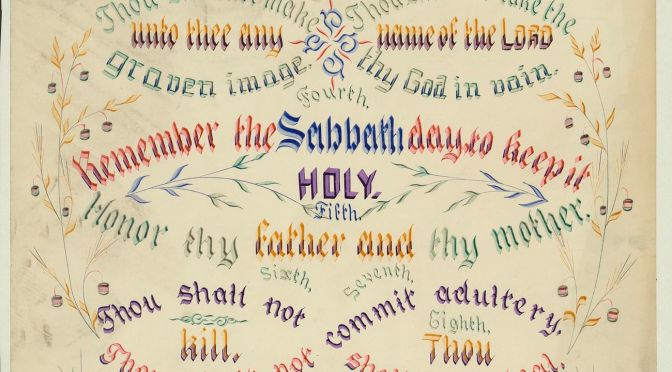
WHAT DOES THE NINTH COMMANDMENT MEAN TO CHRISTIANS? — BOB PRICHARD

The ninth commandment states: “Thou shalt not bear false witness against thy neighbor” (Exodus 20:16). The essence of the commandment is honesty. It seems that many today believe that honesty is not only not the best policy, but unnecessary except in the most extreme circumstances. Our words do matter, though. The psalmist said, “Let the words of my mouth, and the meditation of my heart, be acceptable in thy sight, O LORD, my strength, and my redeemer”  (Psalm 19:14). The words of our mouths and the meditations of our hearts are inseparably linked. The enemies of Jesus did not use their tongues for truth. “O generation of vipers, how can ye, being evil, speak good things? for out of the abundance of the heart the mouth speaketh. A good man out of the good treasure of the heart bringeth forth good things: and an evil man out of the evil treasure bringeth forth evil things” (Matthew 12:34-35). 

The prohibition of bearing false witness is most literally the giving false witness in court. Lying under oath is always a serious crime. Paul told the Ephesians, “Wherefore putting away lying, speak every man truth with his neighbour: for we are members one of another” (Ephesians 4:25). Falsehood in court is a serious sin against one’s neighbor. For the Christian, lying hurts the very members of the body of Christ. 

Words falsely used can have devastating effect. Lies such as slander, designed to hurt others, are especially hurtful. Jesus criticized the Pharisees for their slander of John, the forerunner of His ministry. “For John came neither eating nor drinking, and they say, He hath a devil” (Matthew 11:18). Christ’s enemies would tell any lie to stop Him. “Now the chief priests, and elders, and all the council, sought false witness against Jesus, to put him to death” (Matthew 26:59). James warned that we must be kind and honest with our tongues: “Therewith bless we God, even the Father; and therewith curse we men, which are made after the similitude of God. Out of the same mouth proceedeth blessing and cursing. My brethren, these things ought not so to be” (James 3:9-10). To remain silent in the face of evil, withholding love and concern, also violates the sense of the command. 

Jesus called Satan the father of lies (John 8:43-44). When we lie because we are filled with hatred, or to make ourselves look better, or to avoid unpleasantness, or for financial gain, we place ourselves squarely in the camp of Satan. 

The words of the Christian must be words of truth. Jesus said, “I am the way, the truth, and the life: no man cometh unto the Father, but by me” (John 14:6). Solomon warned, “A false witness shall not be unpunished, and he that speaketh lies shall perish” (Proverbs 19:9). Revelation 21:8 warns: “But the fearful, and unbelieving, and the abominable, and murderers, and whoremongers, and sorcerers, and idolaters, and all liars, shall have their part in the lake which burneth with fire and brimstone: which is the second death.” Liars face the same fate as murderers and idolaters! Psalm 119, the longest chapter in the Bible has as its subject the love of God’s word and love of truth. These are fundamental to the life of the Christian!