
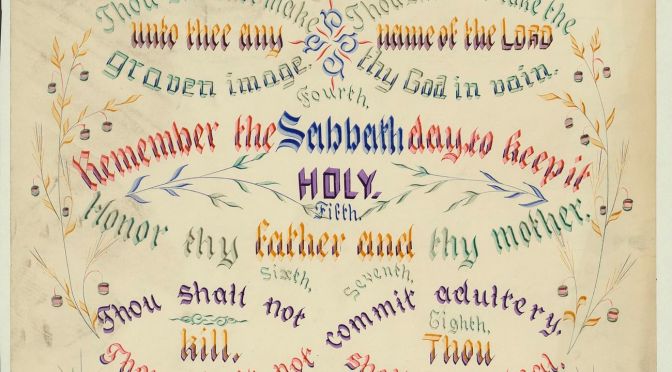
The tenth commandment deals with an “internal” sin, one that may be known only to God and the sinner. It warns against coveting: “Thou shalt not covet thy neighbour’s house, thou shalt not covet thy neighbour’s wife, nor his manservant nor his maidservant, nor his ox, nor his ass, nor any thing that is thy neighbour’s” (Exodus 20:17). Coveting is an evil desire that leads to other sins. James wrote, “But every man is tempted, when he is drawn away of his own lust, and enticed. Then when lust hath conceived, it bringeth forth sin: and sin, when it is finished, bringeth forth death” (James 1:14-15). Death is the ultimate result of coveting. Not every desire is sinful. The commandment gives a summary of basic categories of possessions, and condemns the sinful lusting for that which belongs to others.
The sin of coveting has long plagued mankind. The sin of Adam and Eve was not just in the taking of the forbidden fruit, but their desire to “be as gods, knowing good and evil” (Genesis 3:4). After their great victory at Jericho, God’s people were defeated at Ai, because of the covetousness of Achan who saw among the spoils of Jericho an expensive garment, silver and gold, which he coveted. He took them, and brought death upon the Israelites and his own family.
Many have fallen when they coveted. Ahab coveted Naboth’s vineyard, and lost his life. David coveted Uriah the Hittite’s wife, Bathsheba, and brought tremendous pain on himself, his family, and his kingdom. Paul spoke of the seriousness of covetousness: “What shall we say then? is the law sin? God forbid. Nay, I had not known sin, but by the law: for I had not known lust, except the law had said, Thou shalt not covet. But sin, taking occasion by the commandment, wrought in me all manner of concupiscence [covetous desires]. For without the law sin was dead” (Romans 7:8).
Covetousness, being a secret sin, is betrayed by actions. The life of the tax collector Zacchaeus betrayed his misplaced priorities, put right by his contact with Christ. Many show the hold covetousness has on them by where they place their treasure. Jesus said, “Lay not up for yourselves treasures upon earth, where moth and rust doth corrupt, and where thieves break through and steal: But lay up for yourselves treasures in heaven, where neither moth nor rust doth corrupt, and where thieves do not break through nor steal: For where your treasure is, there will your heart be also” (Matthew 6:19-21). Many times a covetous heart is revealed by a conversation that speaks only of money and materialism. Christians who cannot get over their worries may betray an attitude of covetousness, because the kingdom of God is not their first priority. Perhaps even worse, the attitude that “the end justifies the means” betrays a heart of covetousness. No doubt Demas tried to rationalize his sinful behavior. Paul lamented, “Demas hath forsaken me having loved this present world” (2 Timothy 4:10).
Paul warns: no covetous man “hath any inheritance in the kingdom of Christ and of God” Ephesians 5:5). Jesus focused on the heart, “for out of the heart proceed evil thoughts, murders, adulteries, fornications, thefts, false witness, blasphemies” (Matthew 15:19). Avoiding covetousness means trusting God and relying on His grace.
 THE BIBLE MESSENGER