
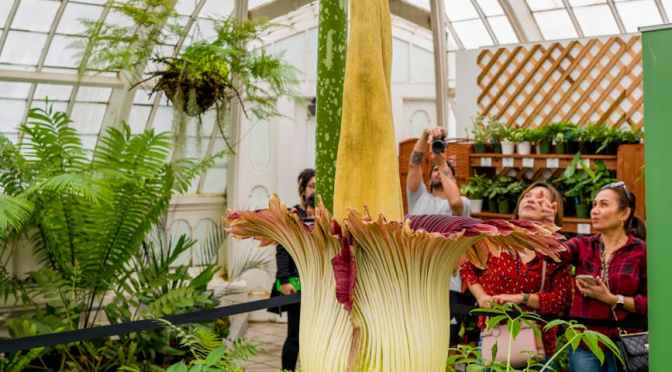
One of the rare events of the century happened on July 30, 1996. The Titan arum, the largest flower in the world, bloomed at London’s Kew Garden. The ten foot tall flower, that was growing at the rate of four to six inches a day just before blooming, rarely blooms. The flower in Kew Garden had previously bloomed only four times, in 1889, 1901, 1926 and 1963. July 30, 1996 was a red letter day for the rare plant native to the forests of Sumatra, Indonesia.
The anticipated blooming was a little off schedule, however, and few were around to “enjoy” the signature scent of Titan arum as it bloomed at 8:00 p.m. that night. I say “enjoy,” because the nickname for the plant is “the corpse flower,” because of its distinct scent. Botanist Peter Boyce described its overpowering scent as “a mixture of rotting flesh and burning sugar, with ammonia over the top.” The smell, that others thought was like the odor of fish, went away after a few hours. Naturalist David Attenborough said that the the odor was not designed to be appealing to humans, but was attractive to the sweat bee. It seems that a gas mask is the proper attire for appreciating the blooming plant (USA TODAY, August 1, 1996).
No doubt Titan arum has a particular place in God’s creation, along with snakes, spiders, scorpions, and mosquitoes. It is a shame, though, that the biggest flower in the world stinks when it blooms. It is probably a good thing that it rarely blooms.
Have you known any “Titan arums”? There are some who think of themselves as the “biggest flowers in the garden,” but when they “bloom,” they stink. Diotrephes must have been a “Titan arum.” John told the beloved Gaius, “I wrote unto the church: but Diotrephes, who loveth to have the preeminence among them, receiveth us not. Wherefore, if I come, I will remember his deeds which he doeth, prating against us with malicious words: and not content therewith, neither doth he himself receive the brethren, and forbiddeth them that would, and casteth them out of the church” (3 John 1:9-10).
How much better it would be if we all were the fragrant flowers of the garden, giving off a sweet scent, whether we were big flowers or little flowers. Solomon thought fondly of his lover: “A garden enclosed is my sister, my spouse; a spring shut up, a fountain sealed. Thy plants are an orchard of pomegranates, with pleasant fruits; camphire, with spikenard, Spikenard and saffron; calamus and cinnamon, with all trees of frankincense; myrrh and aloes, with all the chief spices: A fountain of gardens, a well of living waters, and streams from Lebanon” (Song of Solomon 4:12-15).
Paul thought of the Philippian’s care for him, saying “I have all, and abound: I am full, having received of Epaphroditus the things which were sent from you, an odour of a sweet smell, a sacrifice acceptable, wellpleasing to God” (Philippians 4:18). He reminds us that the saved “are unto God a sweet savour of Christ” (2 Corinthians 2:15). Bloom where you are planted, but don’t make others wish you hadn’t bloomed!

 THE BIBLE MESSENGER