Tag Archives: Discipleship

LOST YEARS — BOB PRICHARD

A study of the life of Christ reveals a stark fact. Although there is abundant information about His birth and the events associated with His earliest childhood, we know nothing about His  life between those days and the beginning of His public ministry at age thirty, with the exception of the incident in the temple when He was twelve years old. What was he doing in the intervening years?

In Jesus: A Biography from a Believer, Paul Johnson suggests that Jesus probably worked at a number of different professions, including that of a shepherd and that of a farmer, since He used so many illustrations from the world of the shepherd and the farmer. Surely Joseph  taught Jesus the trade of carpentry. Teaching in the synagogue, He astonished the people , who said, “Is not this the carpenter, the son of Mary, the brother of James, and Joses, and of Juda, and Simon? and are not his sisters here with us? And they were offended at him” (Mark 6:3). From this statement, we surmise that Joseph was no longer living, so Jesus likely waited to begin His public ministry until he had fulfilled his responsibility as the oldest son to care for His mother and younger brothers and sisters, not yet adults.

Although we have no inspired description of those “lost years,” we can see that they were not lost years but years of preparation. The incident in the temple demonstrates that from His youth Jesus was preparing for His life’s work. Mary said, “Son, why hast thou thus dealt with us? behold, thy father and I have sought thee sorrowing. And he said unto them, How is it that ye sought me? wist ye not that I must be about my Father’s business?” (Luke 2:48–49). He knew what was needed was to serve His heavenly Father. He knew He was pursuing knowledge, preparing for His public ministry. When fulness of the time came (Galatians 4:4), He was totally prepared for His ministry. He gave us an example to follow in His suffering (1 Peter 2:21), but also in preparation for service. Are you in a period of “lost years”? Make it a time of preparation for service.

LOST YEARS — BOB PRICHARD

A study of the life of Christ reveals a stark fact. Although there is abundant information about His birth and the events associated with His earliest childhood, we know nothing about His  life between those days and the beginning of His public ministry at age thirty, with the exception of the incident in the temple when He was twelve years old. What was he doing in the intervening years?

In Jesus: A Biography from a Believer, Paul Johnson suggests that Jesus probably worked at a number of different professions, including that of a shepherd and that of a farmer, since He used so many illustrations from the world of the shepherd and the farmer. Surely Joseph  taught Jesus the trade of carpentry. Teaching in the synagogue, He astonished the people , who said, “Is not this the carpenter, the son of Mary, the brother of James, and Joses, and of Juda, and Simon? and are not his sisters here with us? And they were offended at him” (Mark 6:3). From this statement, we surmise that Joseph was no longer living, so Jesus likely waited to begin His public ministry until he had fulfilled his responsibility as the oldest son to care for His mother and younger brothers and sisters, not yet adults.

Although we have no inspired description of those “lost years,” we can see that they were not lost years but years of preparation. The incident in that temple demonstrates that from His youth Jesus was preparing for His life’s work. Mary said, “Son, why hast thou thus dealt with us? behold, thy father and I have sought thee sorrowing. And he said unto them, How is it that ye sought me? wist ye not that I must be about my Father’s business?” (Luke 2:48–49). He knew what was needed was to serve His heavenly Father. He knew He was pursuing knowledge, preparing for His public ministry. When fulness of the time came (Galatians 4:4), He was totally prepared for His ministry. He gave us an example to follow in His suffering (1 Peter 2:21), but also in preparation for service. Are you in a period of “lost years”? Make it a time of preparation for service.

WHO’S IN CHARGE? — BOB PRICHARD

“No man can serve two masters: for either he will hate the one, and love the other; or else he will hold to the one, and despise the other. Ye cannot serve God and mammon” (Matthew 6:24).

The old saying warns, “Too many cooks spoil the broth.” The thought is that someone (hopefully the best cook), will be in charge, without everyone trying to make the soup. The same is true of the “soup” of our life. Many voices, many masters are clamoring for control of our lives. Mammon, “material wealth” is especially loud in demanding our attention. But as the rich fool learned, what matters is being “rich toward God” (Luke 12 21).

How to be rich toward God is simple: we make Him the Master of our lives. He is the pilot of our lives, the guide for all we do. Knowing that He is our Master, so many decisions of life are simplified. We look to Jesus, because, “he that hath seen me hath seen the Father” (John 14:9).

Is it any wonder that so many are in hot water today because of their divided loyalties?

JESUS GAVE IT ALL— JOSH ALLEN

An old article by William McCormack, entitled “Jesus Christ Gave All” lists numerous ways Jesus gave of Himself. I have adapted and expanded this list.

Jesus gave it all.

He gave His cheek to receive the kiss of betrayal. Now His betrayer had given them a sign, saying, “Whomever I kiss, He is the One; seize Him.”Immediately he went up to Jesus and said, “Greetings, Rabbi!” and kissed Him” (Matthew 26:48-49). “But Jesus said to him, ‘Judas, are you betraying the Son of Man with a kiss?’” (Luke 22:48)

He gave His wrists to be bound. “Then the detachment of troops and the captain and the officers of the Jews arrested Jesus and bound Him.” (John 18:12)

He gave His face to be spat upon“They spat in His face…” (Matthew 26:67)

He gave His “other cheek” (Matthew 5:39) to those who would slap Him and strike Him repeatedly. “Then they spat in His face and beat Him; and others struck Him with the palms of their hands” (Matthew 26:67, Cf. John 19:3)

He gave His tongue to silence. He made no defense before His accusers. He could have brilliantly defeated their arguments (Cf. Matthew 22:46) “But Jesus kept silent…” (Matthew 26:63, Cf. Mark 15:3-4)

He gave His back to the scourge. “So then Pilate took Jesus and scourged Him.” (John 19:1)

He gave His shoulders to wear the robe of mockery. “Then the soldiers of the governor took Jesus into the Praetorium and gathered the whole garrison around Him. And they stripped Him and put a scarlet robe on Him.” (Matthew 27:27-28)

He gave His brow to be pierced by thorns — “When they had twisted a crown of thorns, they put it on His head, and a reed in His right hand. And they bowed the knee before Him and mocked Him, saying, ‘Hail, King of the Jews!’” (Matthew 27:29)

He gave His head to be struck. “Then they spat on Him, and took the reed and struck Him on the head.” (Matthew 27:30)

He gave His eyes to be blindfolded while evil men played a wicked game. “Now the men who held Jesus mocked Him and beat Him. And having blindfolded Him, they struck Him on the face and asked Him, saying, ‘Prophesy! Who is the one who struck You?’ And many other things they blasphemously spoke against Him.” (Luke 22:63-65)

He gave His legs to bear the weight of His Cross“And He, bearing His cross, went out to a place called the Place of a Skull, which is called in Hebrew, Golgotha” (John 19:17). Evidently, He struggled for “…they found a man of Cyrene, Simon by name. Him they compelled to bear His cross” (Matthew 27:32)

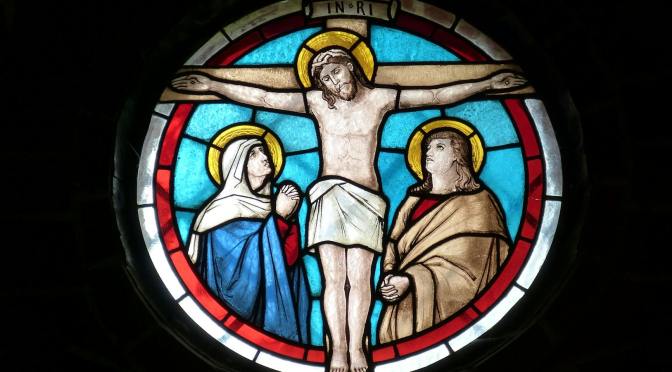
He gave His hands and feet to the nails of the cross. “Then they crucified Him” (Matthew 27:35)

He gave His clothes to His executioners. “Then the soldiers, when they had crucified Jesus, took His garments and made four parts, to each soldier a part, and also the tunic. Now the tunic was without seam, woven from the top in one piece. They said therefore among themselves, “Let us not tear it, but cast lots for it, whose it shall be,” that the Scripture might be fulfilled which says: ‘They divided My garments among them, And for My clothing they cast lots.’ Therefore the soldiers did these things.” (John 19:23-24)

He gave His forgiveness to those who hated Him. “Then Jesus said, “Father, forgive them, for they do not know what they do.” (Luke 23:34)

He gave His ears to endure mocking, blasphemous cries. “And those who passed by blasphemed Him, wagging their heads and saying, ‘You who destroy the temple and build it in three days, save Yourself! If You are the Son of God, come down from the cross.’ Likewise the chief priests also, mocking with the scribes and elders, said, ‘He saved others; Himself He cannot save. If He is the King of Israel, let Him now come down from the cross, and we will believe Him. He trusted in God; let Him deliver Him now if He will have Him; for He said, ‘I am the Son of God.’ ’ Even the robbers who were crucified with Him reviled Him with the same thing.” (Matthew 27:39-44)

He gave His mother to His disciple. “When Jesus therefore saw His mother, and the disciple whom He loved standing by, He said to His mother, ‘Woman, behold your son!’ Then He said to the disciple, ‘Behold your mother!’ And from that hour that disciple took her to his own home.” (John 19:25-27).

He gave His lips to drink the bitter cup. “After this, Jesus, knowing that all things were now accomplished, that the Scripture might be fulfilled, said, ‘I thirst!’ Now a vessel full of sour wine was sitting there; and they filled a sponge with sour wine, put it on hyssop, and put it to His mouth. So when Jesus had received the sour wine, He said, ‘It is finished!’…” (John 19:28-30; Cf. Psalm 69:20-21)

He gave His spirit into the hands of the Father. “And when Jesus had cried out with a loud voice, He said, ‘Father, into Your hands I commit My spirit.’ Having said this, He breathed His last.” (Luke 23:46)

He gave His side to the spear. “Therefore, because it was the Preparation Day, that the bodies should not remain on the cross on the Sabbath (for that Sabbath was a high day), the Jews asked Pilate that their legs might be broken, and that they might be taken away. Then the soldiers came and broke the legs of the first and of the other who was crucified with Him. But when they came to Jesus and saw that He was already dead, they did not break His legs. But one of the soldiers pierced His side with a spear, and immediately blood and water came out. And he who has seen has testified, and his testimony is true; and he knows that he is telling the truth, so that you may believe. For these things were done that the Scripture should be fulfilled, “Not one of His bones shall be broken.” And again another Scripture says, ‘They shall look on Him whom they pierced.’” (John 19:31-37)

He gave His body to be brutalized. “But He was wounded for our transgressions, He was bruised for our iniquities; The chastisement for our peace was upon Him, and by His stripes we are healed.” (Isaiah 53:5)

He gave His blood for redemption. “For this is My blood of the new covenant, which is shed for many for the remission of sins” (Matthew 26:28). Peter reminds us that we “were not redeemed with corruptible things, like silver or gold, from your aimless conduct received by tradition from your fathers, but with the precious blood of Christ, as of a lamb without blemish and without spot.” (1 Peter 1:18-19). 

Jesus gave much more than one can ever imagine. “For you know the grace of our Lord Jesus Christ, that though He was rich, yet for your sakes He became poor, that you through His poverty might become rich” (2 Corinthians 8:9, Cf. Philippians 2:5-11). Jesus gave everything for everyone so that He might give everything to everyone. Jesus gave it all for you, and what does He want of you? He wants your all. 

“‘…And you shall love the Lord your God with all your heart, with all your soul, with all your mind, and with all your strength.’ This is the first commandment.’” (Mark 12:28-30, Cf. Luke 9:23-25)

THE BEST DEAL IN U. S. HISTORY — BOB PRICHARD

It has been called the best business deal in U. S. History (at least before the computer era). It happened in 1903, when John and Horace Dodge, brothers who owned a machine shop in Detroit, made a deal with the Ford and Malcolmson Company. Henry Ford and Alex Malcolmson had decided to manufacture automobiles, but Ford had such a bad reputation for failure, that they could not raise all the cash they needed. Malcolmson became so worried about the possibility of failure that he decided to take his name off of the company, lest he also be associated with failure. The only way that they could raise the needed capital was to offer the Dodge brothers 10% of the company for $3,000 cash and $7,000 in auto parts.

Four weeks after the loan, the Ford Motor Company was about to fold, with $223.65 in the bank, payroll for the Ford workers due the next day, and not a single car sold. But that day, Dr. E. Pfennig, a dentist, paid $850.00 cash for a Ford Model A. From that day forward, Ford Motor Company took off. By 1914, the Dodge brothers were manufacturing their own automobiles, but still had that 10% stake in Ford Motor Company. When they were bought out in 1919, they sold their Ford stock for $25 million. With the $9.5 million they had made in dividends from 1903-1919, their total return on their initial $10,000 was $34.5 million. Not a bad return for two men who began with a bike repair shop! 

While we might be tempted to be envious of the good fortune and business savvy of the Dodge brothers, what the Lord offers to do for us is by far a better deal. A $10,000 investment in 1903 was really a sizable investment, but it paid great dividends, and was really valuable when cashed in. God asks of us that we give ourselves to Him, wholeheartedly, and without reservation. Jesus said, “If any man will come after me, let him deny himself, and take up his cross daily, and follow me” (Luke 9:23). Yes, it is costly, but consider the dividends it pays in this life. We have a spiritual family to love and support us, we have fellowship with the greatest people on earth, and we can live lives with clear consciences, knowing that we are His children, and He loves us. “If we walk in the light, as he is in the light, we have fellowship one with another, and the blood of Jesus Christ his Son cleanseth us from all sin” (I John 1:7).

Not only are the dividends in this life great, but also the investment of our lives prepares us for an eternal reward. What could be better than spending eternity in a place where “the tabernacle of God is with men, and he will dwell with them, and they shall be his people, and God himself shall be with them, and be their God. And God shall wipe away all tears from their eyes; and there shall be no more death, neither sorrow, nor crying, neither shall there be any more pain: for the former things are passed away” (Revelation 21:3-4)? That’s a thousand times better than the Dodge brothers’ deal!