Tag Archives: Apostles

WAS PETER THE FIRST POPE? WHERE DID THE IDEA OF A POPE COME FROM? — BOB PRICHARD

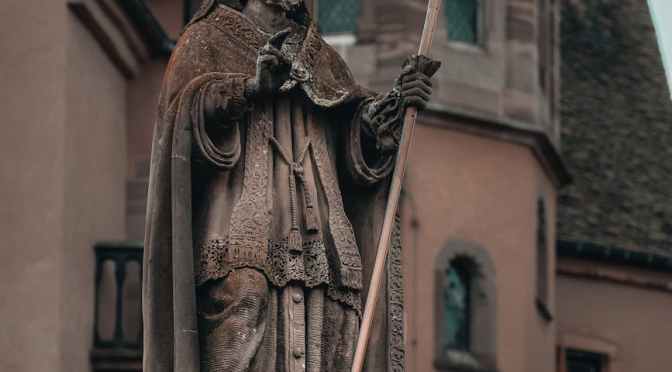
According to Roman Catholic doctrine, the pope is the successor to the apostle Peter, who established the papacy by becoming the first bishop of Rome, and pope of the church. The word “pope” is derived from a Latin word meaning father. Today’s pope, in addition to his title of pope has other titles, including the vicar of Christ (having universal authority over the church), successor of St. Peter, supreme pontiff of the universal church, archbishop and metropolitan of Roman province, and sovereign of the State of Vatican City. These lofty titles are claimed, however, without a shred of biblical authority.

All popes supposedly follow the precedent of Peter, and claim their authority because Peter is considered the first pope. While there are traditions about Peter as the first pope, the historical evidence is lacking, and the Bible itself shows that Peter could not have been the first pope. In actuality, the papacy evolved over many years, and the bishop of Rome did not claim the title until A.D. 296, more than two centuries after Peter.

Peter could not have been the first pope because there is no biblical evidence that Peter was ever at Rome. The apostle Paul wrote a letter to the church at Rome, and as he closed the letter, he saluted more than twenty persons by name (Romans 16:3-15), but he never even mentioned Peter. In his last letter to Timothy from Rome, Paul wrote “only Luke is with me,” and “at my first answer no man stood with me, but all men forsook me” (2 Timothy 4:11, 16). Clearly, Peter was not in Rome.

It is required of Catholic priests, including the pope, that they be celibate. But Matthew 8:14 speaks of Peter’s  mother-in-law, showing that he was married. In following Christ, Peter left many things, but he did not leave his wife. Paul asked the question, “Have we not the power to lead about a sister, a wife, as well as other apostles, and as the brethren of the Lord, and Cephas [Peter]” (1 Corinthians 9:5). In 1 Peter, Peter called himself an elder, and according to Paul’s letter to Titus, an elder must be the husband of one wife, with faithful children (Titus 1:6). Speaking as an elder, he encouraged other elders to feed the flock of God, and please the chief Shepherd (Jesus Christ).

Paul reports that he “withstood” Peter “to the face, because he was to be blamed.” He had been eating with Gentile Christians before, but he separated himself because of the influence of some Jews who had come from Jerusalem. Peter’s behavior influenced Barnabas to misbehave as well (Galatians 2:11-21). This is hardly proper behavior by a man who is supposed to be the vicar of Christ.

There is no doubt that Peter was a man of great ability, and a special servant of the Lord, but the church was not built on Peter. Jesus promised the keys to the kingdom to Peter as well as the other apostles, after Peter confessed Jesus as the Christ. This was the rock upon which Jesus would build the church—that Jesus is the Christ, not Peter (Matthew 16:15-19). Peter was prominent in the early church, but he was not pre-eminent, the “supreme pontiff.”

WERE CHRIST AND THE APOSTLES MISTAKEN ABOUT HIS RETURN? — BOB PRICHARD

The Lord’s second coming is one of the most often discussed subjects in the New Testament, teaching Christians to eagerly anticipate that return. In the very last section of scripture, the Lord says, “Surely I come quickly” (Revelation 22:20). Paul exhorted, “Knowing the time, that now it is high time to awake out of sleep: for now is our salvation nearer than when we believed. The night is far spent, the day is at hand” (Romans 13:11-12). James adds, “Be ye also patient; stablish your hearts: for the coming of the Lord draweth nigh” (James 5:8). Hearing these words, no doubt many Christians of the first century probably expected the Lord to return immediately. 

Balanced with these and similar passages, however, is the Lord’s assertion that “of that day and hour knoweth no man, no, not the angels of heaven, but my Father only. But as the days of Noe were, so shall also the coming of the Son of man be. For as in the days that were before the flood they were eating and drinking, marrying and giving in marriage, until the day that Noe entered into the ark, And knew not until the flood came, and took them all away; so shall also the coming of the Son of man be” (Matthew 24:36-39). No one knows when He will return, and thus all should be prepared. Paul gave this warning: “For yourselves know perfectly that the day of the Lord so cometh as a thief in the night. For when they shall say, Peace and safety; then sudden destruction cometh upon them, as travail upon a woman with child; and they shall not escape” (1 Thessalonians 5:2-3). How could Paul and Christ so clearly state that no one will know the time of the second coming, if they thought it would be “soon”?

The scriptures thus present the second coming as always imminent [about to happen], but also distant. People have always had difficulty understanding this. Luke tells us that Jesus told a parable of a nobleman giving ten pounds to ten servants, even as he went into a far country “to receive a kingdom,” because “he was nigh to Jerusalem, and because they thought that the kingdom of God should immediately appear” (Luke 19:11-13). The Christian must always “watch and be sober” because the Lord may return any time (1 Thessalonians 5:6), but He may also delay His coming.

While “quickly,” or “at hand” may imply something is to occur in a brief period of time, these terms do not always mean this. When Jesus said “Surely I come quickly” (Revelation 22:20), He was emphasizing that His coming would be sudden. In the same way, indications of something being “at hand” often meant that it was sure to happen, not necessarily immediately. Speaking for the Lord, Moses warned about the fate of Israel: “To me belongeth vengeance, and recompence; their foot shall slide in due time: for the day of their calamity is at hand, and the things that shall come upon them make haste” (Deuteronomy 32:35). This prophecy was not fulfilled for hundreds of years, because God’s standards of time are not the same as man’s. “But, beloved, be not ignorant of this one thing, that one day is with the Lord as a thousand years, and a thousand years as one day” (2 Peter 3:8). Christ and the inspired writers were not mistaken. They were preparing the unprepared for His return. We also must be prepared.