
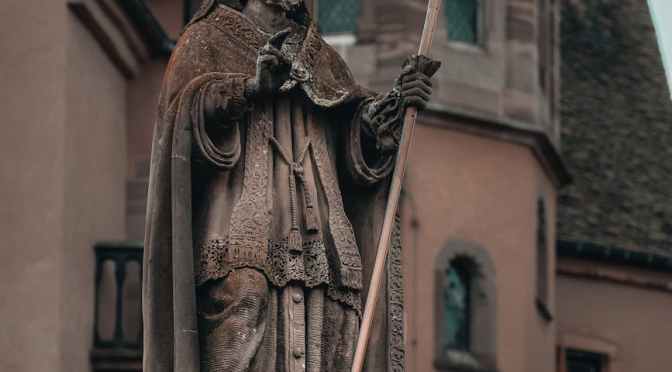
According to Roman Catholic doctrine, the pope is the successor to the apostle Peter, who established the papacy by becoming the first bishop of Rome, and pope of the church. The word “pope” is derived from a Latin word meaning father. Today’s pope, in addition to his title of pope has other titles, including the vicar of Christ (having universal authority over the church), successor of St. Peter, supreme pontiff of the universal church, archbishop and metropolitan of Roman province, and sovereign of the State of Vatican City. These lofty titles are claimed, however, without a shred of biblical authority.
All popes supposedly follow the precedent of Peter, and claim their authority because Peter is considered the first pope. While there are traditions about Peter as the first pope, the historical evidence is lacking, and the Bible itself shows that Peter could not have been the first pope. In actuality, the papacy evolved over many years, and the bishop of Rome did not claim the title until A.D. 296, more than two centuries after Peter.
Peter could not have been the first pope because there is no biblical evidence that Peter was ever at Rome. The apostle Paul wrote a letter to the church at Rome, and as he closed the letter, he saluted more than twenty persons by name (Romans 16:3-15), but he never even mentioned Peter. In his last letter to Timothy from Rome, Paul wrote “only Luke is with me,” and “at my first answer no man stood with me, but all men forsook me” (2 Timothy 4:11, 16). Clearly, Peter was not in Rome.
It is required of Catholic priests, including the pope, that they be celibate. But Matthew 8:14 speaks of Peter’s mother-in-law, showing that he was married. In following Christ, Peter left many things, but he did not leave his wife. Paul asked the question, “Have we not the power to lead about a sister, a wife, as well as other apostles, and as the brethren of the Lord, and Cephas [Peter]” (1 Corinthians 9:5). In 1 Peter, Peter called himself an elder, and according to Paul’s letter to Titus, an elder must be the husband of one wife, with faithful children (Titus 1:6). Speaking as an elder, he encouraged other elders to feed the flock of God, and please the chief Shepherd (Jesus Christ).
Paul reports that he “withstood” Peter “to the face, because he was to be blamed.” He had been eating with Gentile Christians before, but he separated himself because of the influence of some Jews who had come from Jerusalem. Peter’s behavior influenced Barnabas to misbehave as well (Galatians 2:11-21). This is hardly proper behavior by a man who is supposed to be the vicar of Christ.
There is no doubt that Peter was a man of great ability, and a special servant of the Lord, but the church was not built on Peter. Jesus promised the keys to the kingdom to Peter as well as the other apostles, after Peter confessed Jesus as the Christ. This was the rock upon which Jesus would build the church—that Jesus is the Christ, not Peter (Matthew 16:15-19). Peter was prominent in the early church, but he was not pre-eminent, the “supreme pontiff.”
 THE BIBLE MESSENGER