BE NOT CONFORMED — BOB PRICHARD

Poet e. e. cummings (who always seemed weird because he didn’t use capitals in his name), has some wise words in his A Poet’s Advice to Students (1955). “To be nobody-but-yourself—in a world which is doing its best, night and day, to make you everybody else—means to fight the hardest battle which any human being can fight; and never stop fighting.”

His words echo Paul’s warning to the Christians of Rome. After discussing the goodness and severity of God toward the Jews and the Gentiles, he begs them to stand apart from the world. “I beseech you therefore, brethren, by the mercies of God, that ye present your bodies a living sacrifice, holy, acceptable unto God, which is your reasonable service. And be not conformed to this world: but be ye transformed by the renewing of your mind, that ye may prove what is that good, and acceptable, and perfect, will of God” (Romans 12:1–2). 

As cummings and Paul remind us, the world is working overtime to make us like it. The media, the peer pressure, and our own desire to “fit in” make it hard for us to be different. Pressure to conform is severe and subtle at the same time.

If we watch the same TV shows, go to the same movies, engage in the same social and recreational activities, read the same books and magazines, and do what everyone else does, will we be able to be different from the world? The key to resisting the world is to be truly “transformed by the renewing of our minds.” Where is our focus today? “If ye then be risen with Christ, seek those things which are above, where Christ sitteth on the right hand of God. Set your affection on things above, not on things on the earth. For ye are dead, and your life is hid with Christ in God” (Colossians 3:1-3).

Let’s be different, truly different!
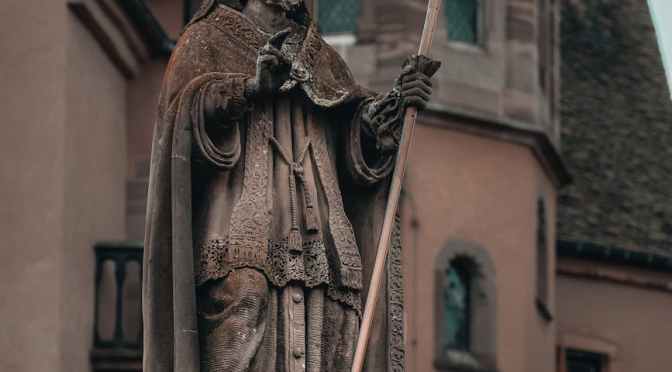
WAS PETER THE FIRST POPE? WHERE DID THE IDEA OF A POPE COME FROM? — BOB PRICHARD

According to Roman Catholic doctrine, the pope is the successor to the apostle Peter, who established the papacy by becoming the first bishop of Rome, and pope of the church. The word “pope” is derived from a Latin word meaning father. Today’s pope, in addition to his title of pope has other titles, including the vicar of Christ (having universal authority over the church), successor of St. Peter, supreme pontiff of the universal church, archbishop and metropolitan of Roman province, and sovereign of the State of Vatican City. These lofty titles are claimed, however, without a shred of biblical authority.

All popes supposedly follow the precedent of Peter, and claim their authority because Peter is considered the first pope. While there are traditions about Peter as the first pope, the historical evidence is lacking, and the Bible itself shows that Peter could not have been the first pope. In actuality, the papacy evolved over many years, and the bishop of Rome did not claim the title until A.D. 296, more than two centuries after Peter.

Peter could not have been the first pope because there is no biblical evidence that Peter was ever at Rome. The apostle Paul wrote a letter to the church at Rome, and as he closed the letter, he saluted more than twenty persons by name (Romans 16:3-15), but he never even mentioned Peter. In his last letter to Timothy from Rome, Paul wrote “only Luke is with me,” and “at my first answer no man stood with me, but all men forsook me” (2 Timothy 4:11, 16). Clearly, Peter was not in Rome.

It is required of Catholic priests, including the pope, that they be celibate. But Matthew 8:14 speaks of Peter’s  mother-in-law, showing that he was married. In following Christ, Peter left many things, but he did not leave his wife. Paul asked the question, “Have we not the power to lead about a sister, a wife, as well as other apostles, and as the brethren of the Lord, and Cephas [Peter]” (1 Corinthians 9:5). In 1 Peter, Peter called himself an elder, and according to Paul’s letter to Titus, an elder must be the husband of one wife, with faithful children (Titus 1:6). Speaking as an elder, he encouraged other elders to feed the flock of God, and please the chief Shepherd (Jesus Christ).

Paul reports that he “withstood” Peter “to the face, because he was to be blamed.” He had been eating with Gentile Christians before, but he separated himself because of the influence of some Jews who had come from Jerusalem. Peter’s behavior influenced Barnabas to misbehave as well (Galatians 2:11-21). This is hardly proper behavior by a man who is supposed to be the vicar of Christ.

There is no doubt that Peter was a man of great ability, and a special servant of the Lord, but the church was not built on Peter. Jesus promised the keys to the kingdom to Peter as well as the other apostles, after Peter confessed Jesus as the Christ. This was the rock upon which Jesus would build the church—that Jesus is the Christ, not Peter (Matthew 16:15-19). Peter was prominent in the early church, but he was not pre-eminent, the “supreme pontiff.”

CAN WE SEPARATE THE HUMAN ELEMENT FROM THE DIVINE IN SCRIPTURE? — BOB PRICHARD

“All scripture is given by inspiration of God, and is profitable for doctrine, for reproof, for correction, for instruction in righteousness: That the man of God may be perfect, thoroughly furnished unto all good works” (2 Timothy 3:16-17). Inspiration literally means “God breathed.” All scripture, or written revelation from God, is thus “God breathed.” Peter described the inspiration of the writers of scripture, saying, “Knowing this first, that no prophecy of the scripture is of any private interpretation. For the prophecy came not in old time by the will of man: but holy men of God spake as they were moved by the Holy Ghost” (2 Peter 1:20-21). The words, “moved by the Holy Ghost,” literally means “borne along,” as a ship is borne along by the winds.

Because God used human beings as the instruments to reveal His will to man, there is necessarily a human element involved in scripture. We see this in things such as the number of medical words found in the writings of Luke, a physician (Colossians 4:14), and in the simple Greek of John, a fisherman, as compared to the more complex Greek of Paul, a highly educated man. Even with differences in style, language, and vocabulary, they all were “moved by the Holy Ghost” to write God’s revelation. Jesus promised the apostles, “the Comforter, which is the Holy Ghost, whom the Father will send in my name, he shall teach you all things, and bring all things to your remembrance, whatsoever I have said unto you” (John 14:26). God was the source of Paul’s writing: “Which things also we speak, not in the words which man’s wisdom teacheth, but which the Holy Ghost teacheth; comparing spiritual things with spiritual” (1 Corinthians 2:13).

The writers could make mistakes in their personal lives. Paul did not remember all that he had baptized (1 Corinthians 9:27). He rebuked Peter for his sin (Galatians 2:11-16), and said of himself, “I keep under my body, and bring it into subjection: lest that by any means, when I have preached to others, I myself should be a castaway” (1 Corinthians 9:27). They still wrote without error, however, because of inspiration.  

God chose those who would reveal His will, even before He formed them, in the case of Jeremiah and others. “Then the word of the LORD came unto me, saying, Before I formed thee in the belly I knew thee; and before thou camest forth out of the womb I sanctified thee, and I ordained thee a prophet unto the nations. … Then the LORD put forth his hand, and touched my mouth. And the LORD said unto me, Behold, I have put my words in thy mouth” (Jeremiah 1:4-5, 9).

Scripture is not “God and man,” but “God through man.” It came from human beings borne along by the Holy Ghost, so we cannot separate the human from the divine. God inspired their very words, so that scripture is without error in faith, science, or history. “God, who at sundry times and in divers manners spake in time past unto the fathers by the prophets, Hath in these last days spoken unto us by his Son, whom he hath appointed heir of all things, by whom also he made the worlds” (Hebrews 1:1-2).

IT’S TOO LATE, THEN — BOB PRICHARD

When you are driving down the interstate, you can’t help but read the bumper stickers and signs on the vehicles in front of you. A sign on a beer truck caught my attention. It read, “The Miller Brewing Company invites you to Think When You Drink.” Illustrating the sign were some broken yellow lines like you see in the center of the highway.

What does “Think When You Drink” mean? Since the sign had a highway illustration, maybe they were telling me that if I drink and drive, I should think about the fact that I am taking my life and the lives of everyone around me in my hands, and risking mayhem and injury, since drunk drivers are fifteen times more likely to be in a fatal accident than non-drinkers.

Perhaps they were telling me that I need to drive carefully so that I will not receive a DUI  (Driving Under the Influence) citation that will jeopardize my driver’s license or increase my insurance premiums by thousands of dollars.

Perhaps they were telling me that since every drink kills brain cells and impairs my judgment, I need to try extra hard when making those split second decisions necessary for driving a vehicle weighing thousands of pounds at sixty-five miles per hour.

I really don’t know what Miller Beer had in mind by saying “Think When You Drink,” because when you begin to drink it is already TOO LATE to think. Every single drink impairs judgment and has its effect. The wisdom of Solomon is still true: “Wine is a mocker, strong drink is raging: and whosoever is deceived thereby is not wise” (Proverbs 20:1).

There are at least ten million alcoholics in the United States, not to mention millions of other problem drinkers. The average alcoholic has four others in the family, and the family suffers tremendously when a member drinks. Alcohol drains more than fifteen billion dollars from the economy each year through lost work time, health and welfare services, property damage, and increased medical costs.

A better slogan for the beer company would be, “Think and Then Don’t Drink.” I don’t expect to see that slogan, though, because it would hurt the sale of their bottled poison.

“Who hath woe? who hath sorrow? Who hath contentions? who hath babbling? Who hath wounds without cause? Who hath redness of eyes? They that tarry long at the wine; They that go to seek mixed wine. Look not thou upon the wine when it is red, When it giveth his colour in the cup, When it moveth itself aright. At the last it biteth like a serpent, And stingeth like an adder” (Proverbs 23:29-32).